
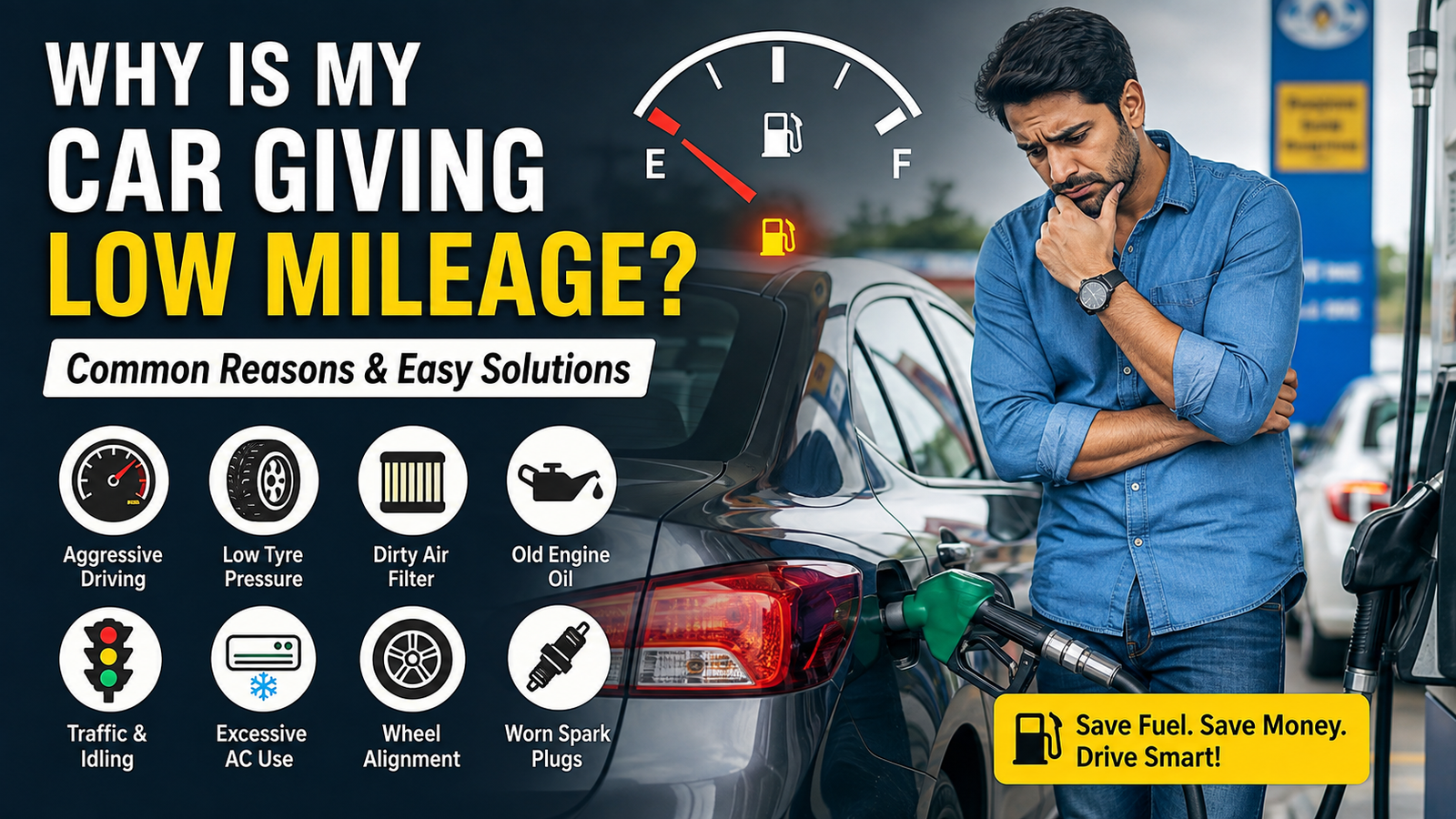
Why is my car giving low mileage? Discover common causes like low tyre pressure, dirty filters, AC use and driving habits, plus easy ways to boost mileage.
If you have a low mileage car, you’re probably spending more money on gas than you need to. You may find that a car that used to give a good mileage suddenly starts guzzling more petrol or diesel. Sometimes the cause is simply a driving habit, and other times the car may need service or repair.
But the good news is that many mileage-related problems can be diagnosed and repaired.
In this guide we will explain why your car is giving low mileage, the common causes, how you can improve fuel efficiency and when you should visit a mechanic.
What Causes Low Mileage in My Car?
Low mileage means your car is using less fuel than it normally should for the kilometers it is covering.
For example, if your car gave you 18 km/l and now is giving you 12-13 km/l, something might have changed.
Typical reasons include:
- Rage on the road
- Low tire pressure
- Inadequate engine maintenance
- Dirty air filter
- Traffic and constant idling
- Too much air-conditioning
- Wheels out of line
- Bad spark plugs (old ones)
- Incorrect fuel
- Carrying extra weight
- Broken sensors
- Clutch issues
- Mostly driving on short trips
Now let’s understand each reason in simple language.
1. Aggressive Driving May Lower Mileage
One of the biggest reasons for low mileage is how you drive.
Fuel consumption can rise with rapid acceleration, sudden braking and driving at very high speeds.
To get better mileage:
- Easy driving.
- Do not brake hard unnecessarily.
- Maintain a steady pace.
- Use the right gear.
- Don’t hurry from one signal to another.
Smooth driving can really make a difference in your fuel economy.
2. Under-inflation (low mileage)
Tyres affect the fuel efficiency of your vehicle directly.
The lower the tyre pressure, the more of the tyre is in contact with the road. This increases the rolling resistance and makes the engine work harder.
Regularly check your tyre pressures and keep them at the level recommended by the manufacturer.
Tip: For an accurate reading check tyre pressure when the tyres are cold.
3. Dirty Air Filter (low mileage)
To burn fuel effectively the engine needs the right quantity of air. A dirty or clogged air filter can limit the flow of air.
If the engine is not getting enough clean air, it will be less fuel-efficient.
If your car hasn’t had a service for a long time, ask the mechanic to check the air filter.
4. May Need To Change Engine Oil
Using old or incorrect engine oil can affect engine performance.
Engine oil cuts down on the friction between moving parts. If the oil is too old, dirty or the wrong grade, the engine may not perform as efficiently as it should.
Use the engine oil recommended by your car manufacturer and follow the service schedule.
5. Too much traffic and idling around
Heavy traffic can make a big difference in mileage.
“If you’re idling and going a lot, the engine is still using fuel, but the car is not going very far.”
Extended idling times also waste fuel.
Turning off the engine can help to avoid unnecessary fuel consumption if you are going to be stationary for a long period of time and it is safe and appropriate to do so (low mileage).
6. Overuse of Air Conditioning
The AC adds onto the engine load . Especially in petrol and diesel cars .
In very hot weather, AC is often necessary, but you can still use it efficiently.
Try:
- Park in the shade when possible.
- Run the AC after a short time of ventilation in the cabin.
- Use AC at proper closed doors and windows while using.
- Poor cooling Have the AC system serviced.
7. Mal-Alignment of Wheels
If your wheels are not aligned correctly, you might find it harder to get your vehicle to roll forward (low mileage).
Symptoms of a wheel alignment problem are:
- Car pulls to the side
- Irregular tire wear
- Volante en recto
- Vehicle feels spongy
If you see these symptoms get the wheel alignment checked.
8. Bad Spark Plug
Spark plugs are used in petrol cars to create the spark to ignite the air-fuel mixture.
Worn or damaged spark plugs may cause:
- Poor acceleration
- Engine misfire
- Idling rough
- Difficulty starting
- Lower mileage
If you see these signs in your car, check the spark plugs.
9. Wrong Fuel Or Poor Quality Fuel
Engine performance and mileage can be affected by fuel quality (low mileage).
If mileage drops suddenly after refueling and especially if this happens at the same location repeatedly, then it is worth thinking about using fuel from a reputable fuel station.
But don’t assume bad fuel is the cause right away. Other mechanical problems can cause similar symptoms.
10. Carrying Too Much Weight
The engine has to work harder to carry the extra weight.
Remove unnecessary things from the boot and cabin specially heavy things that you do not need for daily driving.
While this alone may not change mileage, trimming excess weight may help with efficiency.
11. Bad Sensors Can Hurt Mileage
Modern cars have several sensors that control the engine.
Sensor problems involving air intake, oxygen levels or engine temperature can cause the engine computer to use the wrong fuel mixture.
If your check engine light is on and you’re getting poor mileage, have the car scanned for diagnostic trouble codes.
Don’t just replace a sensor. Proper diagnosis is a must.
12. Clutch issues in a manual vehicle
A worn clutch will also affect fuel economy.
If your engine RPMs are going up but your car is not accelerating properly it may be a slipping clutch.
Other signs are:
- High engine revs
- Poor acceleration
- Smell of Burning
- Power not reaching wheels
A slipping clutch should be checked by a qualified mechanic.
13. Drive only short distances (low mileage)
Short frequent trips can reduce fuel economy.
It may consume more fuel when cold until reaching its normal operating temperature. If you drive only a few kilometers repeatedly, the car may spend a large proportion of the journey warming up.
Sometimes it’s more efficient to combine a couple of short errands into a single trip.
14. Automatic Cars and Driving Behavior
Aggressive driving can also result in poor gas mileage for automatic cars.
Avoid hard acceleration followed by sudden braking. Let the transmission choose the gears for you and drive smoothly.
If your automatic transmission is behaving oddly – delayed shifting, slipping or rough changes of gear – get it checked.
How to get better mileage from your car
Here are a few simple steps to improve fuel efficiency:
- Inflate tyres to the recommended pressure.
- Service the car regularly.
- Check and replace the air filter as needed.
- Use the right engine oil.
- Smooth driving.
- Don’t idle the engine unnecessarily.
- Remove the excess.
- Keep your wheels properly aligned.
- Use AC effectively.
- If your mileage drops suddenly—check the car.
- Don’t drive fast unnecessarily.
- Buy fuel from reputable fuel stations (low mileage).
How Can I Calculate My Car’s Mileage?
The best way is the full tank method.
Fill the gas tank and reset the trip meter.
Drive normally . When you need to gas up . Fill up the tank and note the number of liters added.
Then work out:
Mileage = Kilometers Driven / Liters Consumed
For instance:
So you drove 450 km . You used up 30 liters of fuel :
450 / 30 = 15 km/l
Your car is actually getting around 15 km/l.
Don’t judge mileage on one trip, better to calculate it over several refueling cycles.
When to Visit a Mechanic With Your Car?
Don’t ignore a dramatic and sudden mileage loss, especially if it’s in conjunction with other symptoms.
If you notice: Take it to a mechanic.
- Engine warning lamp
- Engine misfire
- Strange vibration
- Smoke from exhausts
- Poor acceleration
- Strange engine noises
- Strong smell of fuel
- Difficulty starting
- Mileage suddenly drops
- Excessively high engine revs
A professional diagnosis can help pinpoint whether the problem is with the engine, fuel system, sensors, tires, transmission, or other components.
Frequently Asked Questions
Why does my car suddenly have a low mileage?
Sudden loss of mileage can be caused by low tyre pressure, traffic, aggressive driving, AC use, poor maintenance, a clogged air filter, bad sensors, spark-plug problems or other mechanical problems.
Does AC reduce car mileage?
“Yeah. The AC puts an extra load on the engine, and may increase fuel consumption. It is dependent on the car, weather conditions, driving conditions and AC use.
Reducing the tire pressure can cut mileage.
“Yeah. Under-inflated tyres can increase rolling resistance making the engine work harder which can increase fuel consumption.
Does engine oil affect fuel economy?
“Yeah. The right engine oil , changed at the interval recommended by the manufacturer , helps keep the engine running properly . Efficiency can be affected by the wrong oil or very old oil.
Does driving fast hurt gas mileage?
Very high speeds generally increase aerodynamic drag and can decrease fuel efficiency. You’ll generally get better mileage with a smooth acceleration and a sensible, steady speed.
Closing Thoughts
If your car is showing low mileage, don’t immediately assume that there is some major engine problem. Begin with the basics such as tire pressure, driving habits, traffic conditions and regular servicing.
If the mileage has suddenly dropped or you notice symptoms such as poor acceleration, unusual noises or a check-engine light, have the vehicle properly inspected.
Good maintenance and smooth driving are two of the easiest ways to keep your car running smoothly and efficiently and to lower your fuel costs.
Read this also- Tata Punch EV Price, Features & Specs 2026
Read this also- Latest Updates on Kawasaki Z900 (2026)
Read this also- गलती से 5W-20 ऑयल डाल दिया जबकि 5W-30 चाहिए था? यहाँ 10 आसान पॉइंट्स और सही तरीके (Simple Hindi में)




2 thoughts on “Why Is My Car Giving Low Mileage? Common Reasons and Easy Solutions”