
Why Does My Car Vibrate While Driving? Read about the common causes, symptoms, diagnosis, repair costs and simple ways to prevent the automobile vibrations.
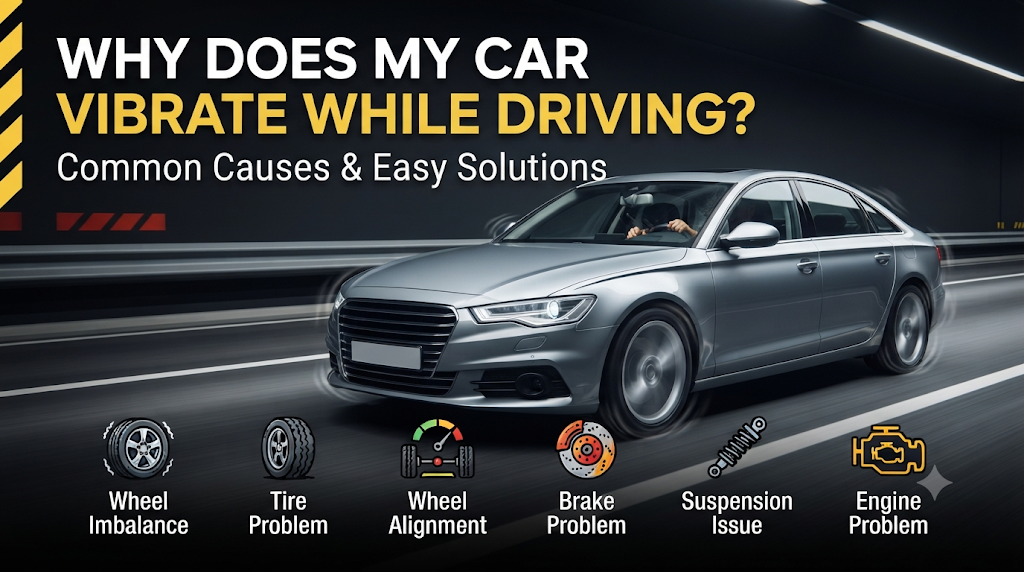
Car shaking while driving can be as simple as an unbalanced tire or as serious as a problem with your suspension, wheel, brakes or engine. The type of vibration and how fast it is can help identify the likely cause (Why Does My Car Vibrate While Driving?).
This guide explains why your car shakes when driving, how to identify the source of the problem, how much it might cost to repair and how to prevent it.
Problem Issue
When your car shakes when driving, you can feel shaking in the steering wheel, seat, floor, or the entire car. In some cases, the vibration can only be felt at a certain speed, sometimes it occurs when braking, accelerating or when the engine is idling.
And don’t forget constant vibration. Even the smallest issue could result in uneven wear on tyres or damage to other components.
Common Symptoms (Why Does My Car Vibrate While Driving?)
The symptoms are a clue as to where the vibration is coming from:
- high speed wheel wobbles
- Vibration of the car on acceleration
- Vibrations on braking
- Low Speed Vehicle Shake
- Floor or seat vibration
- Car slides sideways”
- Uneven tire tread wear
- poor engine performance
- A strange humming or tapping noise
What Could Be Going On
1. Wheels Out Of Balance
Wheel imbalance is a very common cause of vibration at higher speeds . If the wheels are not properly balanced then the steering wheel can vibrate especially while driving on the highway.
Solution: Get all four wheels checked and balanced.
2. Incorrect Wheel Alignment
Poor wheel alignment can cause vibration, uneven tyre wear and steering problems. You may also notice that the car pulls toward one side.
Solution: Have the wheel alignment checked and corrected.
3. Tyre Problems
Damaged, unevenly worn, bulged or improperly inflated tyres can cause vibration. A tyre that has developed a flat spot or has internal damage may also create shaking.
Check tyre pressure according to the manufacturer’s recommended specification and inspect tyres for visible damage.
4. Brake Problems
If the vibration mainly occurs when you press the brake pedal, the brake discs or other braking components may need inspection.
A warped or uneven brake disc can cause steering-wheel or pedal vibration during braking.
5. Suspension Problems
Worn suspension components such as bushings, ball joints, tie rods or shock absorbers can affect vehicle stability and create vibrations.
Suspension problems can become more noticeable when driving over potholes or uneven roads.
6. Engine Problems
If your car vibrates while stationary or when accelerating, the problem may be related to the engine.
Possible causes include:
- Worn engine mounts
- Spark plug problems
- Fuel-delivery issues
- Engine misfire
- Air-intake problems
If the check-engine light is also on, a diagnostic scan may help identify the problem.
7. Driveshaft or CV Joint Problems
In some cars, especially front-wheel-drive or four-wheel-drive vehicles, worn CV joints or driveshaft components can cause vibration during acceleration.
Clicking sounds while turning can also indicate a CV-joint issue.
How to Diagnose the Problem
Start by identifying when the vibration occurs.
Vibration at high speed:
Check tyre balance, tyre condition and wheel alignment.
Vibration during braking:
Inspect brake discs, pads and calipers.
Vibration during acceleration:
Check CV joints, driveshafts, engine mounts and engine performance.
Vibration while idling:
Check engine mounts, spark plugs and possible engine misfires.
A professional mechanic can inspect the tyres, wheels, brakes, suspension and drivetrain and use diagnostic equipment when required.
Solutions (Why Does My Car Vibrate While Driving?)
The repair depends on the actual cause.
- Balance the wheels if they are unbalanced.
- Perform wheel alignment if necessary.
- Repair or replace damaged tyres.
- Replace worn suspension components.
- Inspect and repair brake components.
- Replace damaged CV joints or driveshaft components.
- Replace worn engine mounts.
- Diagnose and repair engine misfires.
Avoid replacing expensive parts without proper diagnosis.
Repair Cost in India (Why Does My Car Vibrate While Driving?)
The cost depends heavily on the car model and the damaged component. Typical indicative ranges are:
| Repair | Approximate Cost |
|---|---|
| Wheel balancing | ₹400–₹1,000 |
| Wheel alignment | ₹500–₹1,500 |
| Tyre replacement | ₹3,000–₹15,000+ per tyre |
| Brake disc replacement | ₹3,000–₹12,000+ |
| Suspension repair | ₹2,000–₹15,000+ |
| Engine mount replacement | ₹2,000–₹10,000+ |
| CV joint repair | ₹2,000–₹8,000+ |
These are general estimates and can vary according to the vehicle, parts and workshop.
How to Prevent Car Vibrations
Regular maintenance can help prevent many vibration-related problems.
- Maintain the correct tyre pressure.
- Balance and align wheels when required.
- Rotate tyres according to the manufacturer’s recommendation.
- Inspect tyres regularly.
- Service the brakes on time.
- Check suspension components periodically.
- Avoid driving over potholes at high speed.
- Follow the recommended service schedule.
FAQs
Why does my car vibrate at high speed?
The most common causes include wheel imbalance, tyre problems and alignment issues. Have the wheels and tyres inspected if vibration becomes noticeable at highway speeds.
Why does my car vibrate when braking?
Vibration during braking can be related to brake discs, pads, calipers or other braking components. Professional inspection is recommended.
Why does my car vibrate when accelerating?
Possible causes include CV joints, driveshaft components, engine mounts or an engine-related problem.
Is it safe to drive a car that is vibrating?
It depends on the cause and severity. Mild vibration may be caused by a relatively simple issue, but severe or sudden vibration can indicate a safety-related problem. If the car is difficult to control, has damaged tyres, makes loud mechanical noises or shows warning lights, stop driving when it is safe and have it inspected.
Can tyre pressure cause vibration?
Yes. Incorrect tyre pressure can contribute to uneven handling and vibration. Check all tyres and maintain the pressure recommended by the vehicle manufacturer.
How do I fix a vibrating car?
The first step is to identify when and where the vibration occurs. A mechanic can then inspect the tyres, wheels, brakes, suspension, drivetrain and engine to determine the correct repair.
Final Thoughts
If you are wondering “Why Does My Car Vibrate While Driving?”, don’t ignore the problem. Wheel imbalance and tyre issues are common, but vibrations can also indicate brake, suspension, drivetrain or engine problems.
Pay attention to when the vibration happens—during acceleration, braking, high-speed driving or while idling. This information can help a mechanic diagnose the issue faster and prevent unnecessary repair expenses (Why Does My Car Vibrate While Driving?).
Also read:
Brake Problems: Warning Signs, Causes, Diagnosis, Solutions & Cost
Why Is My Car Losing Power While Driving? Causes & Solutions




3 thoughts on “Why Does My Car Vibrate While Driving? Causes, Symptoms, Diagnosis & Solutions”