
E20 petrol problems explained in plain English. Learn about E20, whether it reduces car mileage, damages engine life, symptoms and how to avoid problems.
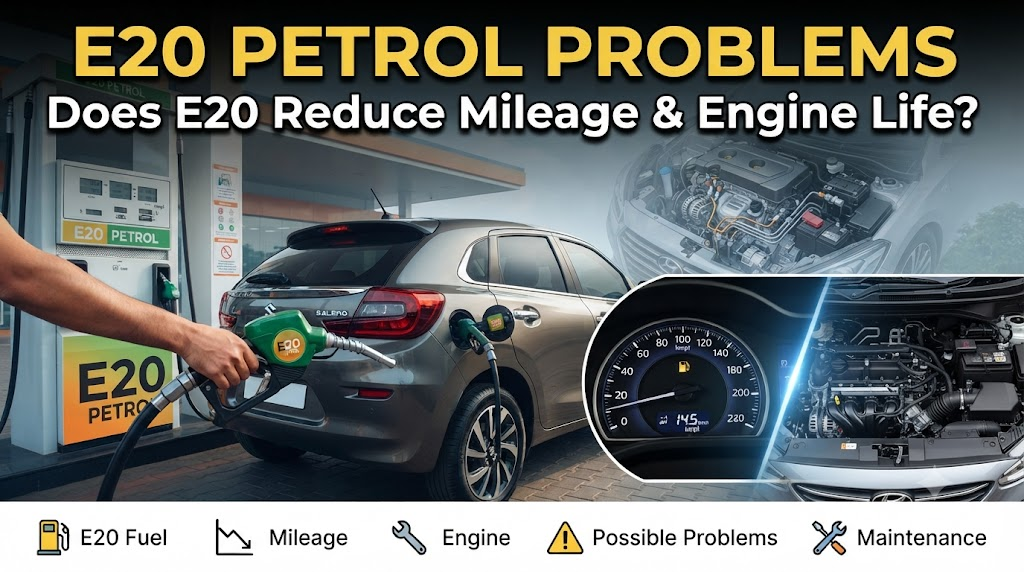
E20 petrol is a blend of 20% ethanol and 80% petrol. India’s ethanol blending program has been making progress toward E20-compatible vehicles. This has also created questions regarding E20 Petrol Problems especially mileage, engine life, starting and maintenance.
E20 fuel is designed to be safely used in modern cars that are E20 compatible. But older cars not built or certified for E20 may need some special attention. SIAM says vehicles from April 2023 onward are made E20 material-compliant and vehicles from April 2025 are being made E20 engine tuning.
Issue Problem
The primary concern about E20 Petrol Problems is that ethanol is less energy dense per liter than petrol. Hence, some vehicles may get marginally lower fuel economy on E20.
That doesn’t mean every car will suddenly see a huge drop in mileage. SIAM says that tests on a range of older vehicles showed a marginal drop in fuel economy and that actual mileage is also affected by driving style, maintenance, tyre condition, use of AC and age of vehicle.
Another concern is with older cars designed for lower ethanol blends. Compatible fuel system materials and proper engine calibration may be required for ethanol.
Symptoms and Signs
Possible problems with E20 Petrol include:
- Mileage slightly reduced
- Engine running roughly
- Difficult to start in some older cars
- Poor acceleration
- Engine check warning
- Degradation of fuel-system component in non-compatible legacy vehicles
- Higher fuel consumption
However, these symptoms are not automatically the fault of E20. Low tyre pressure, dirty filters, bad driving habits, old spark plugs or lack of maintenance can also reduce the mileage.
What Might Be Going On
Possible reasons for E20 Petrol Problems include using E20 in a vehicle not approved for it, unsuitable fuel-system materials, incorrect engine calibration or an existing mechanical problem.
Components of older vehicles might be designed around lower ethanol blends. Modern E20 compliant vehicles are built with suitable materials, seals and calibration to cope with the fuel.
SIAM also highlights that new petrol vehicles have been designed to be compatible with E20, and the government has mandated E20 certification requirements for applicable petrol vehicles manufactured from April 2025.
Diagnosis.
How to identify E20 petrol problems? Look at the owner manual or manufacturer’s fuel recommendation for your vehicle Check for an E20 compatibility label or manufacturer information.
If you notice your mileage dropping suddenly, check your fuel economy over several tanks of fuel rather than just one trip.
A mechanic can see:
- OBD trouble codes
- spark plug
- Fuel injectors
- Parts for fuel system
- Sensors on the engine
- Fuel pressure
- Air Cleaners
- Tyre pressure
- “Engine performance
If the vehicle is E20 compatible and there is no mechanical fault, there is normally no reason to assume that E20 itself has damaged the engine.
Solutions.
The right solution for E20 Petrol Problems depends on the vehicle and the actual fault.
If your vehicle is capable of running on E20, continue to fill up as directed by the manufacturer and keep the vehicle maintained properly.
If you have an older vehicle, check with the manufacturer for the approved ethanol blend before using E20 regularly. If your car starts having starting, running or fuel system problems, have it professionally inspected instead of blindly replacing parts.
Don’t use fuel additives to “cancel out” ethanol unless your vehicle maker specifically recommends one.
Repair Costs
E20 Petrol Problems Cost. The cost will depend on the part that is affected. Simple diagnostic scan can cost around Rs 500-1500 while cleaning or replacing parts like injectors, fuel pumps, hoses or seals can cost substantially more depending on the vehicle.
There is no standard “E20 repair cost” as such because E20 cars should not normally need any special repairs simply because E20 fuel is used as recommended.
Have it diagnosed and estimated before you approve repairs.
Will E20 Reduce Engine Life?
One big question about E20 Petrol Problems is does E20 reduces the life of an engine.
“Normal use of E20 does not automatically shorten engine life,” he says. “A properly engineered modern car is E20-compatible. Manufacturers have altered materials, fuel-system parts and engine calibration for use with E20. SIAM also said that the transition has been designed keeping in mind the safety and durability of the vehicles.
The situation may be different for older, non-compatible vehicles. So it’s more important to find out whether E20 is ok for your specific car rather than assume it’s bad for all petrol engines.
Preventive
Know Your Vehicle’s Approved Fuel Blend – a key step to Avoid E20 Petrol Problems
Try these easy tips:
- Read the owner’s manual.
- Follow manufacturer’s fuel recommendations.
- Keep the car serviced regularly.
- Check tyres regularly to ensure they are at the recommended pressure.
- Change filters and spark plugs as necessary.
- Watch for sudden changes in mileage.
- Don’t ignore the check-engine warning.
- “Fuel from reputable sources.
Regular maintenance may also help identify problems that would be wrongly blamed on E20.
FAQs
E20 and Car Mileage ? Does E20 reduce Car Mileage ?
Yes, E20 Petrol Problems can involve a slight decrease in fuel economy as ethanol has a lower energy content per liter. What really makes a difference is the car and the driving conditions. The reduction in tested vehicles is marginal, according to SIAM.
Is E20 safe for new vehicles?
Use E20 in vehicles approved for it to minimize E20 Petrol Problems. Modern E20-compliant vehicles are specifically designed and tuned for the fuel.
Can E20 harm an old car?
E20 petrol problems are more prevalent in older cars that were not designed to run on higher ethanol blends. Check manufacturer’s recommendation before regular use.
Will E20 reduce the life of the engine?
E20 Petrol Problems do not automatically mean a reduced engine life for E20-compatible vehicles. Proper servicing and the right fuel are essential.
How do I increase mileage on E20?
To reduce the effect of E20 Petrol Problems keep the tyre pressure correct, drive smoothly, avoid unnecessary idling and keep the engine well serviced.
Should I avoid E20 fuel?
Don’t automatically steer clear of E20. E20 Petrol Problems are highly dependent on vehicle suitability and maintenance. Follow the advice of your particular car’s manufacturer.
Can E20 cause check engine light?
In some instances a check-engine light may be connected to E20 Petrol Problems, however it may also be a sign of a number of other unrelated faults. Always test the vehicle before blaming the fuel.
Disclaimer
This article on E20 Petrol Problems is for general information. Fuel compatibility depends on the vehicle, model year and manufacturer. Always follow the instructions of your car manufacturer and if you see unusual symptoms in the engine or fuel system, seek the help of an authorized service center or qualified mechanic. E20 Petrol Problems should be diagnosed by a professional and not just assumed from changes in mileage.
Also read:
Brake Problems: Warning Signs, Causes, Diagnosis, Solutions & Cost
Why Is My Car Losing Power While Driving? Causes & Solutions




6 thoughts on “E20 Petrol Problems: Mileage & Engine Life Explained”