
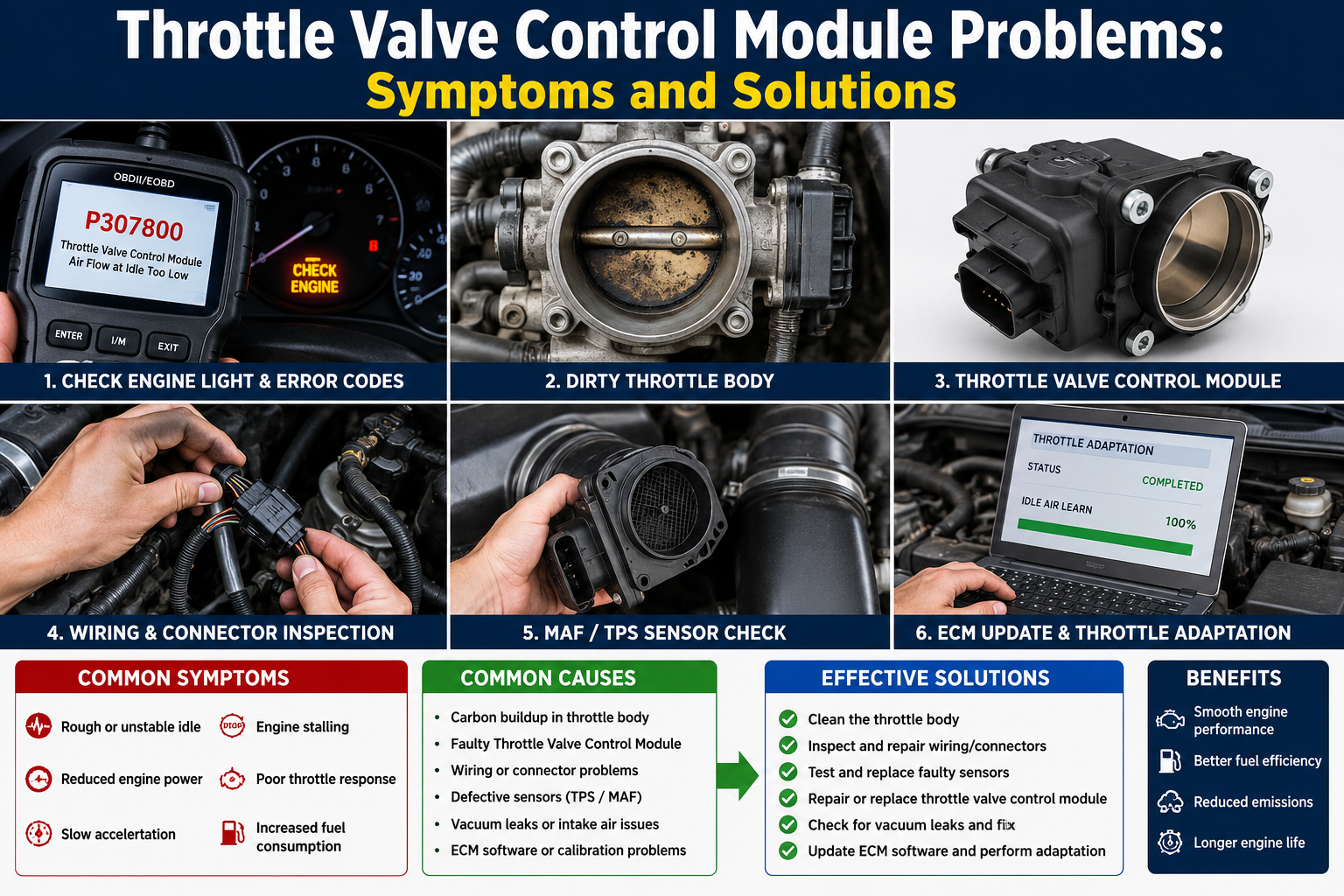
P155800, P210600 and P154500 throttle valve fault codes explained in detail. Learn the causes, symptoms, diagnostic procedure, throttle actuator faults, wiring problems, Mechanical problem imtake air system checheck limited power mode and proper repair strategy.
When the ECU detects that the throttle valve is not responding correctly, it can store multiple related Diagnostic Trouble Codes (DTCs). Three important codes in this area are:
- P155800 – Throttle Valve Drive Malfunction – Passive/Sporadic
- P210600 – Throttle Actuator Control System Forced Limited Power – Passive/Sporadic
- P154500 – Throttle Valve Control System Malfunction – Passive/Sporadic
I am going to talk about the throttle body. The specific issue I am discussing concerns a fully electrical throttle body—not a cable-operated one. It connects via the accelerator pedal’s throttle position sensor and is operated by the ECU. Today, we will explore this entire system, so stay tuned for the full blog. When these three codes appear together, the problem should not automatically be treated as three separate failures. In many cases, they can be different consequences of a single underlying problem within the electronic throttle control system.
«Important: Exact DTC definitions and diagnostic procedures can vary by manufacturer, engine and ECU software. Always verify the code against the vehicle manufacturer’s service information before replacing components.»
P155800 Throttle Valve Drive Malfunction
P155800 Throttle Valve Drive Malfunction indicates that the ECU has detected an abnormality in the operation or control of the throttle valve drive system.
Inside an electronic throttle body, an electric motor moves the throttle plate according to commands from the ECU. The ECU then monitors feedback from throttle position sensors to determine whether the actual throttle position corresponds with the commanded position.
If the ECU detects an abnormal actuator response, unexpected throttle movement, excessive deviation or another control problem, it may store P155800.
Potential causes include:
- Carbon or oil contamination inside the throttle body
- Throttle plate sticking or binding
- Defective throttle actuator motor
- Internal throttle body electronics failure
- Throttle position sensor malfunction
- Damaged wiring
- Loose or corroded electrical connector
- Open circuit or short circuit
- Poor electrical ground
- Low battery voltage
- Charging-system voltage instability
- Throttle adaptation failure
- ECU software/calibration problem
- Incorrect installation of a replacement throttle body
Depending on the vehicle and severity of the fault, the driver may experience:
- Check Engine Light
- Poor acceleration
- Delayed accelerator response
- Engine hesitation
- Rough or unstable idle
- RPM fluctuation
- Reduced engine power
- Limp-home mode
- Poor throttle response
- Difficulty maintaining engine speed
- Intermittent performance problems
Because the code is described as Passive/Sporadic, the problem may not be present continuously. The vehicle might operate normally during one drive and then experience a throttle-control problem under different temperature, vibration, voltage or operating conditions We will learn how to diagnose it and first we will do a visual inspection.
P210600 – Throttle Actuator Control System Forced Limited Power
What Does P210600 Mean?
P210600 – Throttle Actuator Control System Forced Limited Power is particularly important because it indicates that the engine management system has entered or requested a power-limiting strategy.
The ECU uses electronic throttle control as part of engine torque management. If it cannot reliably control or verify throttle operation, it may restrict engine output as a protective measure.
This condition is commonly associated with:
- Reduced Power Mode
- Limp Mode
- Fail-Safe Operation
- Limited Throttle Response
The exact strategy varies between manufacturers.
Why Does the ECU Limit Engine Power?
The ECU must know exactly how much air and torque the engine can produce. If the commanded throttle position and actual throttle position do not agree, or if the ECU detects an unreliable throttle-control signal, unrestricted engine operation may no longer be considered safe.
Therefore, the ECU can deliberately limit throttle opening or engine torque.
This is why P210600 should not simply be interpreted as “the engine has low power.”
It can indicate that the ECU itself has deliberately restricted engine performance because of a throttle-control problem.
Common Causes of P210600
- Throttle actuator motor failure
- Throttle plate sticking
- Excessive carbon deposits
- Throttle position sensor fault
- Accelerator pedal position sensor problem
- Wiring or connector failure
- Low battery voltage
- Poor power or ground connection
- Throttle adaptation failure
- Internal throttle body electronics failure
- Related throttle-control DTCs
- ECU software or calibration problems
P154500 – Throttle Valve Control System Malfunction
What Does P154500 Mean?
P154500 – Throttle Valve Control System Malfunction is a broader fault indicating a problem somewhere within the throttle valve control system.
The electronic throttle system can be viewed as a complete control chain:
Accelerator Pedal → ECU → Throttle Actuator → Throttle Plate → Position Feedback → ECU
A failure anywhere in this control chain can potentially result in throttle-related DTCs.
Potential Causes of P154500
Common areas to investigate include:
- Dirty or contaminated throttle body
- Sticking throttle plate
- Throttle actuator motor failure
- Throttle position sensor malfunction
- Accelerator pedal position sensor problem
- Damaged wiring
- Loose connector
- Connector corrosion
- Low system voltage
- Poor engine or chassis ground
- Failed throttle adaptation
- ECU or software-related problem
What Does It Mean When All Three Codes Appear Together?
This is one of the most important parts of the diagnosis.
If a scan tool reports:
P155800 + P210600 + P154500
do not immediately assume that three separate components have failed.
A common fault can create a chain reaction:
Throttle Body Problem
↓
Abnormal Actuator Operation
↓
Throttle Position Feedback Does Not Match Command
↓
ECU Detects Throttle Control Malfunction
↓
Multiple Throttle DTCs Stored
↓
Engine Power Restricted
↓
P210600 – Forced Limited Power
For example, a sticking throttle plate could cause the actuator motor to struggle to achieve the commanded position. The ECU detects the deviation, records a throttle-control fault and then activates a reduced-power strategy.
Similarly, a loose connector or temporary voltage drop could interrupt throttle actuator operation and generate multiple related codes.
What Does “Passive/Sporadic” Mean?
The term Passive/S… Sporadic is extremely important during diagnosis.
Generally, it means that the fault has been detected and stored in the ECU’s fault memory, but it may not currently be active.
This can happen because of:
- Intermittent wiring
- Loose electrical connectors
- Temporary voltage drop
- Battery weakness
- Moisture intrusion
- Connector corrosion
- Heat-related electrical faults
- Vibration-related connection problems
- Temporary actuator sticking
- A fault that occurs only under specific driving conditions
Therefore, a technician should not dismiss the code simply because it is not active during the current scan.
Advanced Diagnostic Procedure
Step 1: Perform a Complete Vehicle Scan
Do not diagnose these codes in isolation.
Perform a complete diagnostic scan and record:
- Current DTCs
- Stored DTCs
- Pending faults
- Freeze-frame information
- ECU communication faults
- Accelerator pedal-related codes
- Throttle position-related codes
- Voltage-related codes
The order in which the codes appeared can also be useful.
If another fault was recorded before the throttle codes, that earlier fault may be the root cause.
Step 2: Analyze Freeze-Frame Data
Freeze-frame data can reveal the operating conditions when the ECU detected the problem.
Where available, examine:
- Engine RPM
- Vehicle speed
- Engine temperature
- Battery/system voltage
- Accelerator pedal position
- Throttle position
- Engine load
- Operating time
For intermittent faults, this information can be more valuable than simply clearing the DTC and waiting for it to return.
Step 3: Check Battery and Charging System
This step is often overlooked.
Electronic throttle systems are highly dependent on stable electrical power.
Check:
- Battery condition
- Battery terminals
- Battery voltage
- Charging voltage
- Ground connections
- Voltage drop
- ECU power supply
A weak battery or unstable charging system can cause electronic modules and actuators to behave abnormally.
Therefore, replacing a throttle body without checking system voltage can lead to an unnecessary repair.
Step 4: Inspect the Throttle Body
Perform a careful visual inspection.
Look for:
- Carbon deposits
- Oil contamination
- Throttle plate sticking
- Physical damage
- Damaged connector
- Broken locking mechanism
- Bent pins
- Corrosion
- Moisture
- Damaged wiring
- Harness rubbing
Do not force the throttle plate open or closed unless the manufacturer’s service procedure specifically permits manual movement.
Electronic throttle bodies contain sensitive mechanical and electronic components.
Step 5: Check Throttle Position Live Data
A professional scan tool can provide valuable information through live data.
Where supported, compare:
Commanded Throttle Position vs. Actual Throttle Position
If the ECU commands a particular throttle position but the actual position consistently fails to follow it, further testing is required.
Possible areas include:
- Throttle actuator
- Throttle position sensors
- Wiring
- Mechanical sticking
- Internal throttle body electronics
- ECU control
Live data should always … be interpreted according to manufacturer-specific specifications.
Step 6: Test Wiring and Connectors
Intermittent throttle faults require careful electrical testing.
Inspect and test according to the manufacturer’s wiring diagram:
- Power supply
- Ground
- Signal circuits
- Continuity
- Short to ground
- Short to power
- Connector pin tension
- Voltage drop
- Harness condition
A visual inspection alone may not identify an intermittent electrical problem.
A properly performed wiggle test can sometimes help reproduce an intermittent fault, but it should be performed safely and according to the manufacturer’s procedure.
Step 7: Check Accelerator Pedal Position Signals
The throttle system begins with the driver’s accelerator pedal command.
Therefore, do not inspect only the throttle body.
The diagnostic chain includes:
Accelerator Pedal → ECU → Throttle Actuator → Throttle Position Feedback
If accelerator pedal position signals are abnormal, the ECU may also generate throttle-control faults or activate a reduced-power strategy.
Step 8: Perform Throttle Adaptation When Required
Some vehicles require a Throttle Adaptation, Basic Setting, Initialization or Relearn procedure after:
- Throttle body replacement
- ECU replacement
- Certain electrical repairs
- Battery-related events
- Cleaning or service procedures
However, there is no universal throttle relearn procedure.
One vehicle may support an ignition-based initialization, while another may require a professional scan tool.
Always use the procedure specified by the vehicle manufacturer.
Does P155800 Mean the Throttle Body Must Be Replaced?
NO. N0. NO.
This is one of the biggest diagnostic mistakes.
A DTC identifying a throttle valve or actuator problem does not automatically prove that the throttle body itself is defective.
Before replacement, establish whether the actual cause is:
- Mechanical contamination
- Sticking throttle plate
- Wiring fault
- Connector problem
- Low system voltage
- Ground problem
- Sensor problem
- Adaptation failure
- Actuator motor failure
- Internal throttle body electronics
- ECU/software issue
Only after appropriate testing confirms component failure should replacement be considered.
Can Cleaning the Throttle Body Fix These Codes?
Sometimes—but not always.
If excessive carbon or contamination causes the throttle plate to stick, cleaning may restore proper operation.
However, cleaning will not repair:
- A failed actuator motor
- Damaged position sensors
- Internal electronics
- Broken wiring
- Corroded terminals
- ECU fault
- Intake air system
- mechanical damage check
Throttle body cleaning should be performed carefully and according to manufacturer instructions because aggressive cleaning or improper handling can damage sensitive components.
Common Diagnostic Mistakes
Mistake 1: Replacing the Throttle Body Immediately
A fault code is not automatically proof of component failure.
Mistake 2: Ignoring Battery Voltage
Low voltage can create multiple electronic-control faults.
Mistake 3: Ignoring Wiring
Intermittent wiring problems are particularly important when the DTC is Passive/Sporadic.
Mistake 4: Clearing the Codes Without Diagnosis
Clearing a code does not repair the underlying problem.
Mistake 5: Skipping Adaptation
Some vehicles require throttle initialization after repair or replacement.
Mistake 6: Diagnosing Each Code Separately
P155800, P210600 and P154500 may be interconnected.
A technician should identify the root cause, rather than replacing multiple parts based solely on the number of codes.
When Should You Stop Driving?
If the vehicle experiences:
- Severe loss of acceleration
- Unpredictable throttle response
- Repeated limp mode
- Engine stalling
- Very poor throttle response
- Sudden reduction in engine power
continued normal driving may be unsafe.
Because electronic throttle control directly affects engine torque management, serious or unpredictable throttle symptoms should be professionally diagnosed as soon as possible.
Professional Diagnostic Strategy
A strong diagnostic workflow is:
Complete Vehicle Scan
↓
Record DTCs + Freeze-Frame Data
↓
Check Battery & Charging Voltage
↓
Inspect Throttle Body
↓
Inspect Connectors & Wiring
↓
Check Accelerator Pedal Signals
↓
Analyze Throttle Live Data
↓
Perform Actuator Tests Where Supported
↓
Check Throttle Adaptation/Basic Setting
↓
Repair Confirmed Root Cause
↓
Clear DTCs
↓
Perform Road Test
↓
Re-Scan Vehicle
This approach minimizes unnecessary parts replacement and increases the probability of finding the actual fault.
Final Conclusion
P155800, P210600 and P154500 are important electronic throttle-control related fault codes. When they appear together—particularly as Passive/Sporadic faults—the correct strategy is not to immediately replace the throttle body.
The diagnostic process should begin with the basics: battery voltage, charging system, power supply, grounds, connectors and wiring. After that, the technician should evaluate the throttle body mechanically and electrically, compare commanded and actual throttle positions using appropriate live data, inspect accelerator pedal signals and perform manufacturer-specific throttle adaptation when required.
The most important diagnostic principle is simple:
«A DTC tells you where the ECU detected a problem; it does not always tell you which component must be replaced.»
A successful repair requires identifying the root cause—whether it is contamination, mechanical sticking, an actuator fault, sensor problem, intermittent wiring, low voltage, adaptation failure or an ECU/software issue.
When P155800 + P210600 + P154500 occur together, think of them as a connected Electronic Throttle Control System problem first, and individual component failures second.
2025 Toyota Innova Hycross ZX Hybrid Features and Specifications
Fixing P0016 in Skoda, VW, and Audi: A Step-by-Step Diagnosis