
Learn about E20 petrol problems, compatible cars, mileage concerns, older vehicles, engine effects and how to check if your car supports E20 fuel.
E20 Petrol Problems: Compatible Cars & Effects on Mileage
Introduction
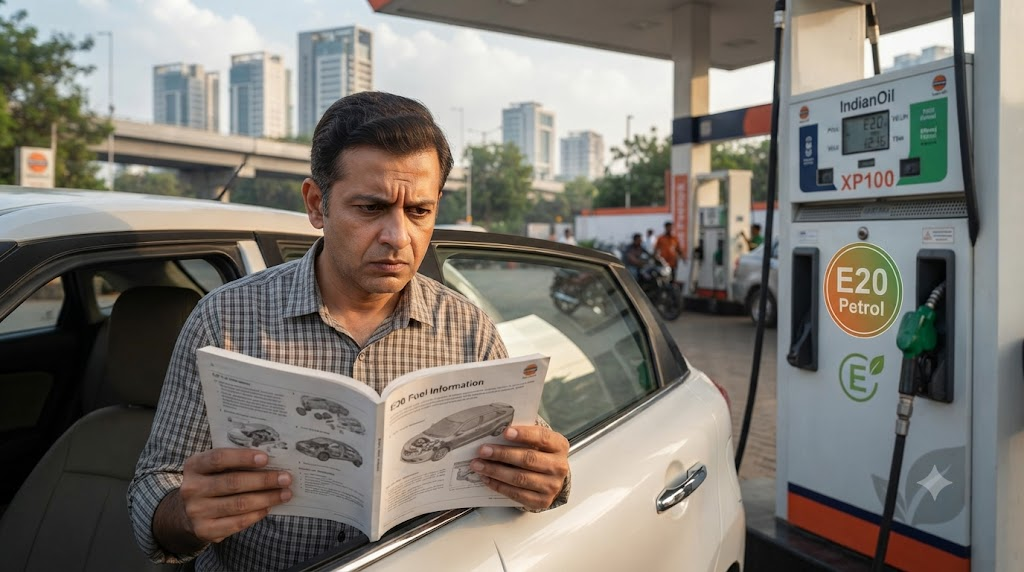
E20 Petrol Problems have become a major discussion among Indian car owners in 2026. E20 petrol means petrol containing up to 20% ethanol. The topic has become even more important because many buyers are now thinking about fuel compatibility before purchasing a new car.
Recent industry data shows that CNG, hybrid and electric passenger vehicles together accounted for 41.95% of India’s passenger-vehicle retail sales in August 2026, slightly higher than petrol/ethanol vehicles at 40.85%. Industry representatives have linked this change partly to concerns about E20 fuel, along with running costs and the wider choice of alternative-fuel vehicles.
But does E20 petrol really damage cars? The answer is not a simple yes or no.
What Is E20 Petrol?
E20 petrol is petrol blended with 20% ethanol and 80% petrol.
India has been increasing ethanol blending to reduce dependence on imported crude oil and support domestic fuel alternatives.
The biggest concern around E20 Petrol Problems is not necessarily that every car will develop an engine problem. Instead, older vehicles may experience changes in fuel efficiency or compatibility depending on their design, age and manufacturer specifications.
FADA president Sai Giridhar recently said that vehicles launched in India from 2023 are E20-compliant, while older vehicles are generally unlikely to face major problems, although some older cars may see lower mileage.
Why Are People Talking About E20 Petrol Problems?
There are several reasons why E20 Petrol Problems are trending.
First, ethanol has different fuel characteristics from petrol. Because of this, fuel economy can change.
Second, many people own older petrol vehicles and want to know whether their cars were designed for higher ethanol blends.
Third, consumers are becoming more careful about long-term maintenance costs.
Finally, the recent shift toward CNG, hybrid and EV cars has made the fuel discussion even bigger.
Reuters reported that alternative-fuel passenger vehicles crossed petrol-powered passenger vehicles in India’s August 2026 sales, with concerns about E20 being one factor mentioned by the dealers’ body.
Does E20 Petrol Reduce Mileage?
This is one of the biggest questions related to E20 Petrol Problems.
The simple answer is: it can affect mileage, especially in some older vehicles.
Ethanol contains less energy per litre than petrol. Therefore, depending on the vehicle and fuel blend, the distance travelled per litre can be different.
However, this does not mean every E20-compatible car will suddenly give very poor mileage.
FADA’s president has specifically said that older cars may experience some mileage reduction, while cars launched from 2023 are E20 compliant.
So, if your car is older, checking the manufacturer’s official compatibility information is more useful than relying only on social media claims about E20 Petrol Problems.
Are New Cars Safe With E20 Petrol?
Generally, newer cars designed for India’s E20 fuel environment are built with the required compatibility in mind.
According to FADA president Sai Giridhar, cars launched from 2023 onward in India are E20 compliant.
This is important because not every petrol car has the same fuel-system design.
If you are buying a new car in 2026, ask the dealer or manufacturer:
- Is this car E20 compliant?
- From which model year is E20 compatibility available?
- What fuel blend does the owner’s manual recommend?
- Will using E20 affect warranty?
- Is there any expected mileage difference?
These questions can help you avoid unnecessary worry about E20 Petrol Problems.
What About Older Petrol Cars?
Older cars are where most of the discussion about E20 Petrol Problems comes from.
If you own a petrol car that is 10, 12 or 15 years old, its fuel system may have been designed around an older ethanol blend.
That does not automatically mean the car will be damaged by E20.
However, some older vehicles may experience reduced mileage or other compatibility-related concerns.
The best approach is to check your owner’s manual or contact the manufacturer’s customer support.
For example, Maruti Suzuki has publicly claimed that its cars made from 2008 onward are E20 compatible. This is a manufacturer-specific claim, so owners of other brands should check their own vehicle’s official information.
Which Cars Are E20 Compatible?
It is difficult to provide one universal list because compatibility can depend on the brand, model, engine and model year.
For newer vehicles, E20 compatibility is increasingly standard in the Indian market.
Some manufacturers are also preparing for even higher ethanol blends. Kia India, for example, has said its engineering capabilities are being developed for fuel blends ranging from E20 to E100.
So instead of asking only “Is my brand E20 compatible?”, check the exact model and manufacturing year.
This is the safest way to understand potential E20 Petrol Problems.
Signs You Should Check Your Car
If you are worried about E20 Petrol Problems, don’t immediately assume that every performance change is caused by E20.
Look for:
- Sudden mileage reduction
- Rough engine running
- Difficulty starting
- Unusual engine behaviour
- Check-engine warning
- Fuel-system issues
- Unusual fuel consumption
These symptoms can have many causes, including old spark plugs, dirty injectors, poor maintenance or fuel-quality issues.
If your car develops a serious problem, get it inspected by an authorised service centre rather than changing parts yourself.
E20 Petrol vs CNG vs Hybrid vs EV
The current fuel discussion is also changing what people consider when buying a new car.
CNG can be attractive for people who drive many kilometres.
Hybrid cars can offer better fuel efficiency without requiring regular charging like a pure EV.
EVs can provide low running costs for drivers who have suitable charging access.
Petrol cars still offer convenience, especially for people who want simple refuelling and long-distance flexibility.
The August 2026 sales data shows that this competition is becoming stronger, with CNG/LPG, hybrids and EVs together reaching 41.95% of passenger-vehicle retail sales.
How to Check If Your Car Supports E20
If you want to confirm your vehicle’s compatibility, follow these simple steps:
Step 1: Check the owner’s manual.
Step 2: Search for ethanol or E20 fuel information.
Step 3: Check the vehicle’s fuel-label or manufacturer documentation.
Step 4: Contact the company’s official customer-care service.
Step 5: Give them your exact model, engine and manufacturing year.
Step 6: Follow the manufacturer’s recommendation.
This is much safer than believing random online posts about E20 Petrol Problems.
Should You Stop Buying Petrol Cars?
No.
The current discussion does not mean petrol cars are suddenly useless.
Modern petrol cars designed for E20 can continue to be practical for many buyers.
Your decision should depend on:
- Daily kilometres
- Fuel availability
- Running cost
- Purchase budget
- Maintenance cost
- Charging availability
- Vehicle age
- Long-distance driving requirements
The recent rise of CNG, hybrid and EV sales shows that Indian consumers now have more choices than before.
What Should Existing Car Owners Do?
If you already own a petrol car, don’t panic because of E20 Petrol Problems.
First, find your vehicle’s manufacturing year.
Then check the owner’s manual.
If your vehicle is E20 compatible, continue using the recommended fuel and follow normal servicing.
If your vehicle is older and you notice mileage or performance changes, visit an authorised service centre.
Most importantly, don’t make expensive modifications based only on social-media rumours.
Final Conclusion
The discussion around E20 Petrol Problems is real, but it should not be exaggerated.
E20 petrol contains 20% ethanol, and newer vehicles are increasingly designed to work with this fuel. FADA has said cars launched from 2023 are E20 compliant, while some older cars may experience a mileage reduction.
At the same time, India’s car market is changing quickly. CNG, hybrid and EV passenger vehicles together overtook petrol/ethanol vehicles in August 2026, showing that buyers are increasingly considering fuel economy, running costs and alternative powertrains.
So, before worrying about E20 Petrol Problems, check your exact car model, manufacturing year and manufacturer’s official recommendation.
FAQs
1. What is E20 petrol?
E20 petrol contains 20% ethanol and 80% petrol.
2. Does E20 petrol damage cars?
E20-compatible cars are designed for this fuel. Older vehicles may have compatibility or mileage concerns, so check the manufacturer’s recommendation.
3. Does E20 reduce mileage?
Some older vehicles may experience a mileage reduction. The effect varies by vehicle.
4. Are new cars E20 compatible?
FADA’s president has said vehicles launched in India from 2023 are E20 compliant.
5. How can I check my car’s E20 compatibility?
Check the owner’s manual or contact the vehicle manufacturer’s official customer support.
6. Should I buy a CNG, hybrid or EV instead of petrol?
It depends on your budget, daily driving distance, fuel availability and charging access.
7. Are E20 Petrol Problems the same for every car?
No. Compatibility can vary according to the manufacturer, model, engine and model year.
Disclaimer:
This article is for general information and educational purposes only. E20 compatibility can vary by vehicle model, engine and manufacturing year. Always check your owner’s manual or contact the vehicle manufacturer for official compatibility information. Do not make vehicle modifications based only on online information.
Also read:
Top 10 Best-Selling Cars August 2026: Tata Punch Leads
TVS Sales August 2026: Electric Two-Wheeler Sales Jump 137% YoY
Fixing P0016 in Skoda, VW, and Audi: A Step-by-Step Diagnosis




1 thought on “E20 Petrol Problems: Which Cars Are Compatible With E20 Fuel in India?”