
Explore the rise of autonomous vehicles, how self-driving technology works, benefits, challenges, and what it means for the future of transportation.
Autonomous Vehicle Revolution
Autonomous vehicles are no longer a thing of science fiction. What once was only possible in the movies is steadily becoming reality on public roads. With advances in sensors, artificial intelligence, mapping and computer power, vehicles are now able to drive with little or no human intervention.
Global innovators like Waymo, Tesla, Inc. and Baidu are investing billions into self-driving systems. Traditional automakers are partnering with tech companies to speed up development. This change will reshape road safety, mobility access and urban transport.
What are self-driving cars?
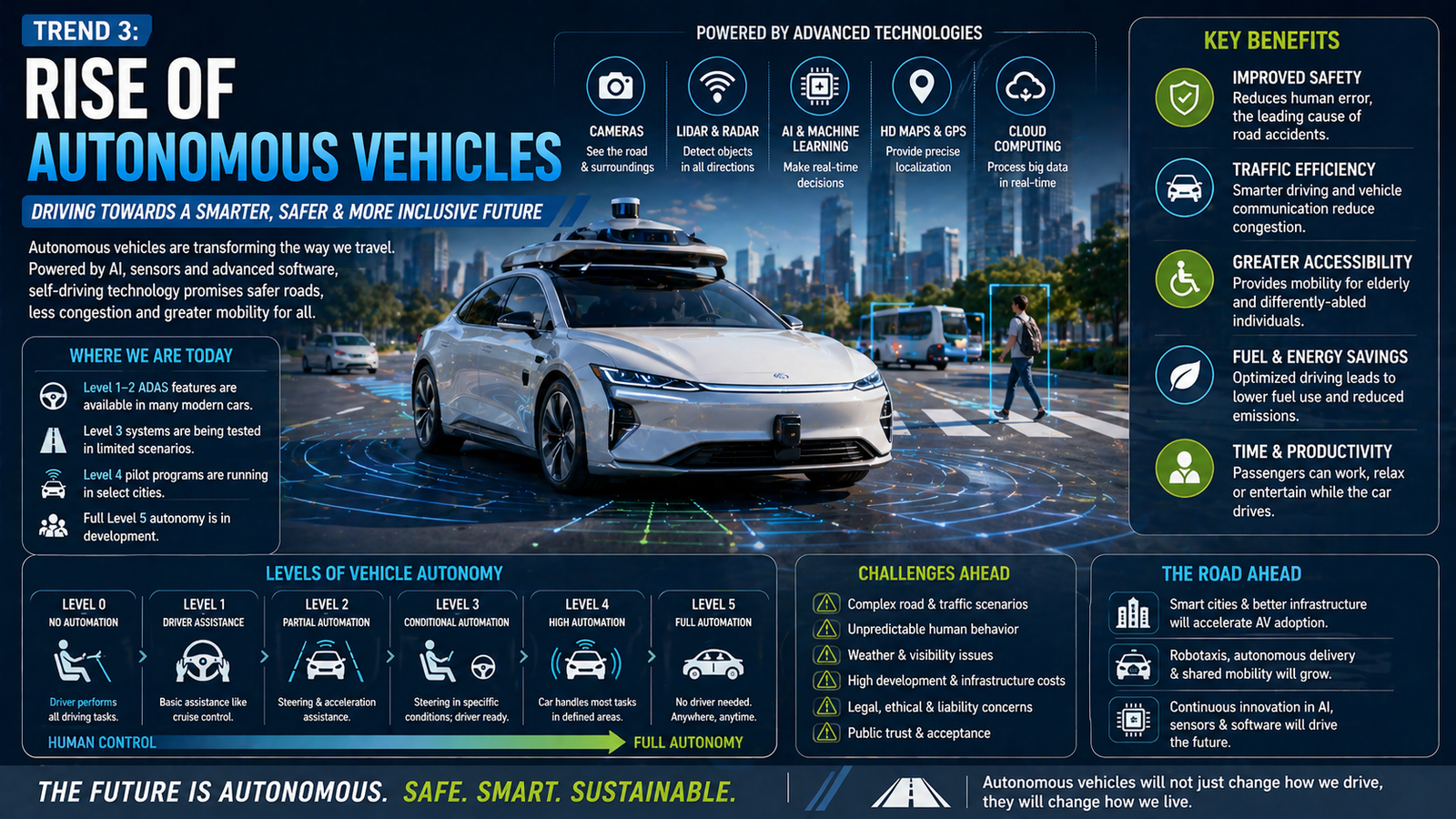
Autonomous vehicles (AVs), or self-driving cars, rely on a combination of:
- Cameras
- LiDAR and Radar Sensors
- GPS and HD-maps
- Artificial Intelligence (AI)
- Onboard computers with great power
Together these elements sense the surroundings, make decisions and control steering, braking and acceleration.
Vehicle Autonomy Levels
The industry has classified autonomy from Level 0 to Level 5:
- Level 0: Fully human (no automation)
- Level 1-2: Driver assist (cruise control, lane assist)
- Level 3: Conditional automation (human ready, car drives)
- Level 4: High automation (small areas, no attention required)
- Level 5: Full automation (no driver needed)
Most cars today are Level 1 or 2, and pilot programs are testing Level 4 in some cities.
How does self-driving technology work?
Autonomous systems do three things:
- Perception: Sensors detect roads, vehicles, and pedestrians.
- Decision AI algorithms choose safest action.
- Control: The vehicle does the steering, throttle and braking.
This loop runs in milliseconds, which is far quicker than human reaction time.
Advantages of Autonomous Vehicles
1) Safer Streets
Most accidents are caused by human error. AVs don’t get tired, distracted, or intoxicated.
2) Traffic Efficiency;
Self-driving cars talk to each other and optimize their speed, reducing congestion.
3. Accessibility
Senior and differently abled people attain independent mobility.
4) Fuel and Energy Efficiency
Smooth driving reduces fuel consumption and battery drain
5) Time Saving
Passengers can work or relax rather than concentrate on the driving.
Testing and Deploying in the Real World
Some companies already run autonomous taxi pilots in geofenced zones. The controlled environments give the systems the opportunity to be fine-tuned before release at large scale.
Smart infrastructure cities are prime early adopters, as HD mapping and connected signals assist AV navigation.
Barriers to Adoption
While progress has been made, key challenges remain:
- Complex traffic situations in cities
- Weather effects on sensors
- High-tech expenses
- Liability and legal issues
- Trust and acceptance by the public
And the rules are still being worked out on who’s responsible if there’s an accident.
AI and Machine Learning Position
AI enables AVs to learn from millions of miles of driving. Machine learning models improve object detection, prediction of pedestrian movement and decision-making in rare scenarios.
The more data AVs gather, the safer they get.
Effects on the Automotive Industry
The rise of autonomous vehicles is changing business models:
- Car companies becoming tech companies
- Working with software and chip companies
- Robotaxis (Mobility-as-a-Service) Growth
- Less focus on traditional driving performance
Implications for India
“Full autonomy is a tough ask with the kind of traffic density and road behavior that you have in India. But assisted autonomy (Level 2-3) is already arriving to premium cars with advanced driver assistance.
With dedicated lanes, improved road marking and smart signals, autonomy can be increased over time.
Predictions for the Future
“Over the next decade:
- Selected smart cities with level 4 AVs
- Self-driving delivery vehicles
- Robotaxi services lower car ownership
- Smart city infrastructure integration •
Self-driving will be a step-by-step process, not overnight.
What Buyers Need to Know
Things to watch out for:
- ADAS features as building blocks
- Support for software updates
- Sensor quality and redundancy
- Investment in autonomy research by brand
They indicate how ready for the future a vehicle is.
SUMMARY
One of the most revolutionary shifts in the history of transportation is the arrival of self-driving cars. While full self-driving for everyone might take some time, steady progress in AI, sensors, and regulations brings us closer each year.
Autonomous technology will drive the future of transport with safer roads, efficient traffic and inclusive mobility.
Rise of Autonomous VehiclesRise of Autonomous VehiclesRise of Autonomous VehiclesRise of Autonomous VehiclesRise of Autonomous VehiclesRise of Autonomous VehiclesRise of Autonomous VehiclesRise of Autonomous VehiclesRise of Autonomous VehiclesRise of Autonomous Vehicles
Read this – Big announcements for Maruti lovers,must see the features
Read this – Kia Seltos Price List 2026 – Complete Review, Specs & Features