
How to Check Car Odometer Tampering: 10 Signs
Learn how to check car odometer tampering, verify used-car mileage, identify warning signs and protect yourself before buying a second-hand car.
Table of Contents
Introduction
Buying a used car with incorrect mileage can lead to unexpected repair costs and a poor buying decision. Some vehicles may show lower kilometres on the dashboard than they have actually travelled. This is commonly known as car odometer tampering.
Learning how to check car odometer tampering can help you compare the displayed mileage with service records, vehicle condition and other available information before buying a second-hand car.
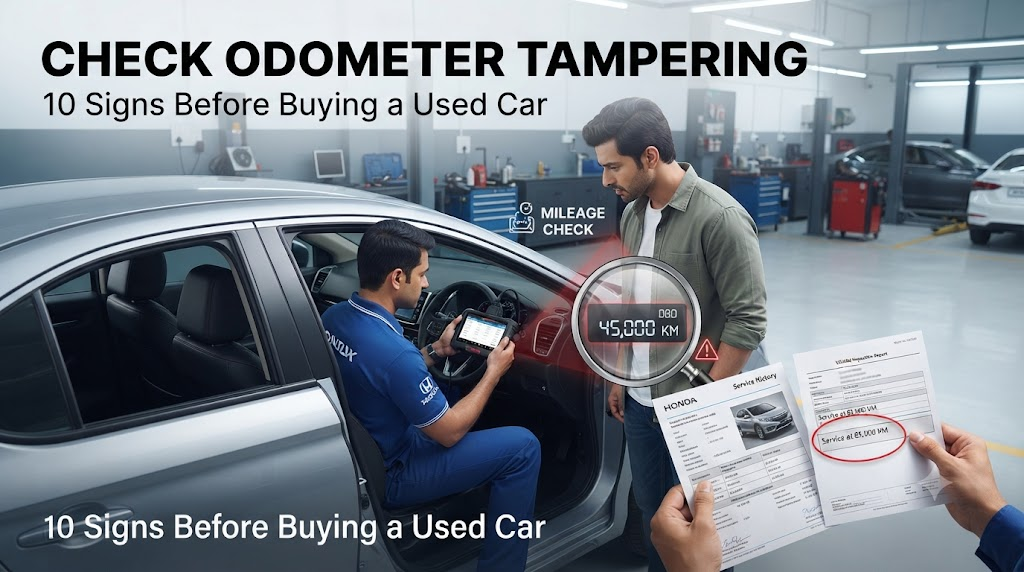
Meaning
An odometer records the distance a vehicle has travelled. Car odometer tampering means intentionally changing, resetting or manipulating the recorded mileage to make the vehicle appear less used.
For example, a car that has travelled 1,20,000 km but displays 70,000 km may have an incorrect odometer reading. However, a mileage difference does not automatically prove fraud because records can sometimes contain genuine errors.
Why Tampering Happens
The main reason for car odometer tampering is to make a used vehicle look more attractive to buyers.
A lower mileage can make a car appear:
- Less used
- Better maintained
- More valuable
- Easier to resell
This is why buyers should not judge a used car only by the number shown on the dashboard.
10 Signs of Odometer Tampering
1. Mileage Does Not Match Service Records
If an old service invoice shows higher mileage than the current odometer, investigate immediately.
2. Large Gaps in Service History
Missing service records can make it difficult to establish the vehicle’s actual mileage.
3. Heavy Steering-Wheel Wear
Excessive wear on the steering wheel compared with very low displayed mileage can be a warning sign.
4. Worn Pedals
Heavily worn brake, clutch and accelerator pedals may suggest extensive use.
5. Damaged Driver’s Seat
A badly worn driver’s seat can be inconsistent with an unusually low odometer reading.
6. Tyres Look Much Older
Check tyre manufacturing dates and condition. Very worn tyres on a supposedly low-mileage car deserve attention.
7. Inconsistent Service Stickers
Old stickers or handwritten maintenance notes may contain mileage information that differs from the dashboard.
8. Unusual Mileage History
A record showing 90,000 km followed later by 60,000 km is a major warning sign.
9. Seller Avoids Questions
A seller who refuses to provide service records or explain mileage inconsistencies should make you cautious.
10. Vehicle Condition Does Not Match Mileage
The overall condition of the engine, suspension, interior, tyres and body should reasonably match the claimed usage.
These signs do not individually prove car odometer tampering, but several together should lead to further investigation.
How to Check
Start with the vehicle’s paperwork and maintenance records. Compare every available mileage entry in chronological order.
Check:
- Service invoices
- Service book
- Insurance documents
- Repair bills
- Inspection reports
- Previous vehicle records
- Authorised service-centre records, where available
A professional inspection can also help identify inconsistencies.
When checking car odometer tampering, do not rely on one document. Compare information from multiple independent sources.
Mileage Verification
Create a simple mileage timeline.
For example:
| Record | Mileage |
|---|---|
| First service | 12,000 km |
| Second service | 25,000 km |
| Third service | 42,000 km |
| Repair invoice | 61,000 km |
| Current odometer | 48,000 km |
Here, the current reading is lower than an older record, which is a serious red flag.
Mileage should generally increase over time. Small recording errors can happen, but unexplained large differences require verification.
Digital Odometer
Modern cars often use digital instrument clusters and electronic control modules. Digital displays do not automatically mean the mileage is impossible to manipulate.
Depending on the vehicle, mileage-related information may be stored in multiple electronic systems. A qualified technician with appropriate diagnostic equipment may be able to identify inconsistencies.
Do not attempt to modify or reset the odometer yourself. Apart from being potentially illegal or fraudulent, incorrect mileage can affect vehicle valuation and maintenance decisions.
Red Flags
Be especially careful when you find:
- No service history
- Missing invoices
- Mileage inconsistencies
- Excessive interior wear
- Unusually low mileage for the vehicle’s apparent age and condition
- Seller refusing an independent inspection
- Dashboard or instrument-cluster replacement without documentation
- Records that conflict with each other
One red flag does not always mean car odometer tampering, but several unexplained inconsistencies should be taken seriously.
Protection
Before buying a used car, protect yourself by:
- Checking service history.
- Comparing multiple mileage records.
- Inspecting the interior and mechanical condition.
- Checking available insurance and repair records.
- Verifying the vehicle identification details.
- Taking a proper test drive.
- Getting an independent inspection.
- Keeping copies of important documents.
Never make a purchase decision based only on a low odometer reading.
What to Do
If you suspect car odometer tampering, ask the seller for an explanation and supporting records.
If the discrepancy cannot be explained, consider walking away from the vehicle. If you still want to buy it, get a professional inspection and make sure the vehicle’s history and paperwork are properly verified.
If you discover suspected fraud after purchasing the vehicle, keep your invoices, advertisements, messages and other relevant documents and seek appropriate professional or legal advice.
Final Checklist
Before buying a used car:
☐ Compare current mileage with service records.
☐ Check old repair invoices.
☐ Look for mileage on inspection documents.
☐ Inspect steering wheel and pedals.
☐ Check driver’s seat wear.
☐ Inspect tyre condition and age.
☐ Look for missing service periods.
☐ Ask about instrument-cluster replacement.
☐ Get an independent diagnostic inspection.
☐ Do not buy if major mileage discrepancies remain unexplained.
This checklist can help you identify possible car odometer tampering before spending your money.
FAQs
Can digital odometers be tampered with?
Digital odometers can potentially be manipulated, so buyers should not assume that a digital display guarantees genuine mileage.
How can I verify used-car mileage?
Compare the odometer with service invoices, repair records, insurance documents and other available historical records.
Is low mileage always a good sign?
No. Low mileage should match the vehicle’s age, condition and documented history.
Can a mechanic detect odometer tampering?
A qualified technician may identify inconsistencies using vehicle diagnostics and physical inspection, although detection methods vary between models.
What is the biggest warning sign?
A mileage reading that is lower than a previously documented mileage is one of the clearest reasons to investigate further.
Should I buy a car with suspicious mileage?
It is safer to avoid the purchase if the seller cannot provide a credible explanation and supporting documentation.
Disclaimer
This article is for general information only. Car odometer tampering can be difficult to identify in some vehicles, and no single inspection method guarantees detection. Always verify available records and have a qualified professional inspect the vehicle before purchasing a used car.
Also read:
3 Upcoming Nissan SUVs in India: New Models Worth Waiting For