
Used Car Inspection Checklist: Check 20 Important Things Before Buying a Used Car – Engine, Tyres, Documents, Body, Test Drive
Table of Contents
Used Car Inspection Checklist: 20 Things to Look For
Buying a used car can save you money, but it can also cost you quite a bit if the car has hidden issues. A good used car inspection checklist will help you to inspect the car’s engine, body, tyres, documents, interior and driving condition before you part with your cash.
If it’s your first car, or you’re moving up to the next car, never take the seller’s word for it. Use this Used Car Inspection Checklist and, if possible, have the car inspected by a mechanic you trust.
Problem
The biggest problem with buying a used car is some problems might not be obvious with a quick inspection. Accident damage, odometer tampering, engine problems, worn tyres and poor maintenance can all increase your ownership cost.
A Used Car Inspection Checklist is a systematic approach to inspecting the vehicle you are about to purchase.
Symptomatology
If you are checking a used car, look out for these warning signs:
- strange engine noise
- Blue, white or excessive exhaust gases
- Irregular tyre-wear
- Leaking oil or coolant
- Dashboard warning lights
- Steering pulls to one side
- Shaking at the wheel
- Trouble shifting gears
- AC not blowing cold
- Paint looks different on body panels
These signs should make you more careful in your inspection.
Potential Causes
There are many reasons a used car may have problems. Engine noise can be a sign of poor maintenance, and uneven tyre wear can indicate alignment or suspension issues.
Signs of repair, such as uneven panel gaps or paint differences, may indicate accident repairs.
A Used Car Inspection Checklist will help you spot these potential problems before you haggle over the price.
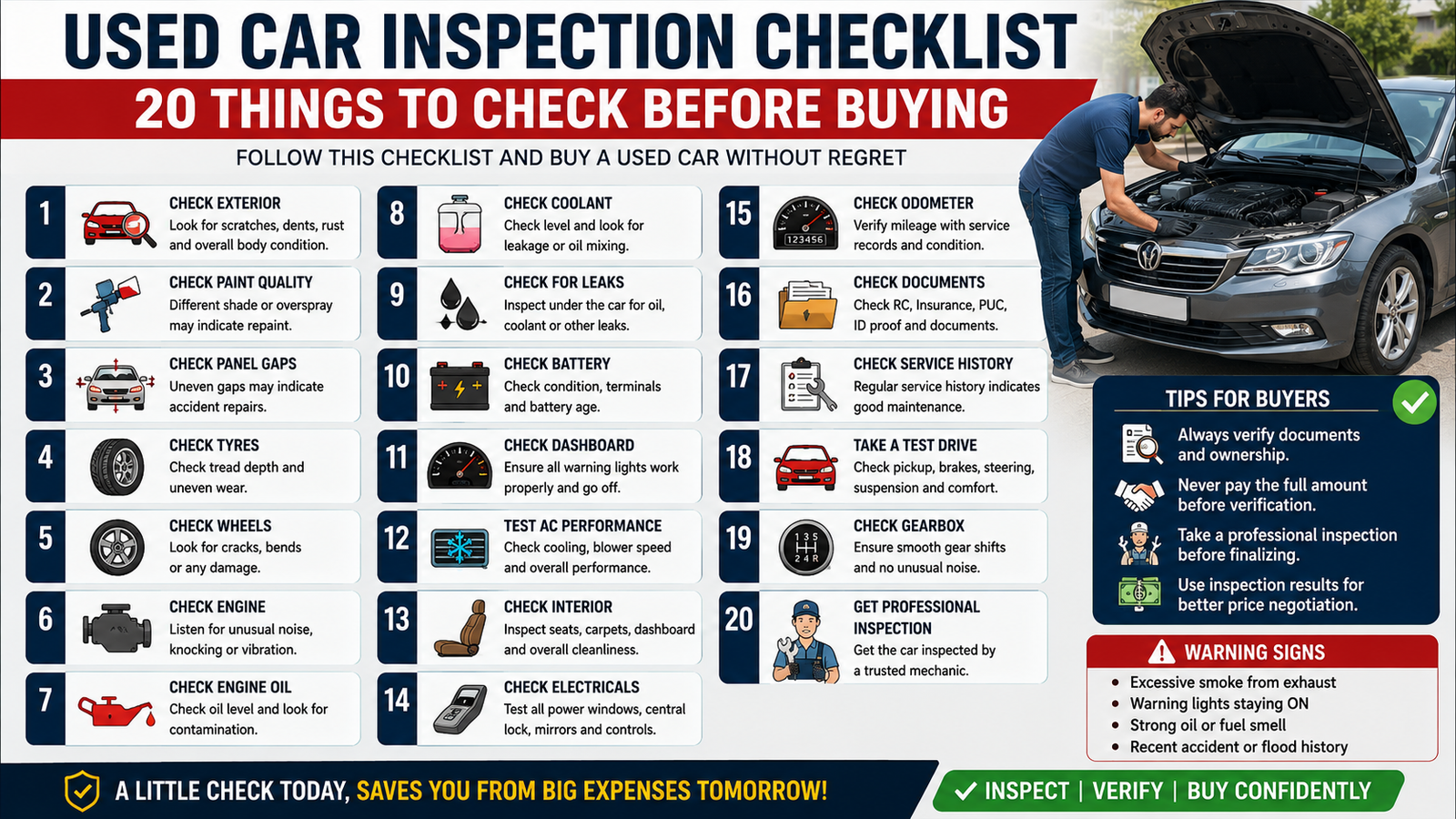
How to Diagnose: 20 Things to Look For
Use this Used Car Inspection Checklist Before You Purchase:
1. Check the outside: Look for scratches, dents, rust and damaged panels.
2. Paint check: Discrepancies in the colour of paint can be a sign of previous bodywork.
3. Check panel gaps: Uneven gaps can be a sign of accident repairs.
4. Check the tyres Check the tread depth and check for uneven wear.
5. Inspect the wheels for cracks and other serious damage.
6. Listen for any unusual knocking, rattling or excessive vibration coming from the engine.
7. Engine Oil Check Verify that the level is correct and there is no sign of contamination.
8. Check coolant for leaks and proper coolant level.
9. Look underneath. Check for any oil, coolant or other fluid leaks.
10. Check the battery: Check its condition and terminals.
11. Check the dashboard: Ensure warning lights are operating properly and are not illuminated after the ignition is turned on.
12. test the AC: Make sure that the cooling and blower functions are working.
13. Interior inspection. Inspect seats, carpets, dashboard and electrical controls.
14. Check windows and locks: Check all the power windows, central lock and mirror.
15. Check the odometer: Compare the mileage shown with the service history and overall condition of the car.
16. Check documents Registration, insurance, pollution certificate where applicable and other relevant records.
17. Check service history: Regular servicing is a good thing.
18. Test drive: Accelerate, brake, steer and test suspension on different road surfaces.
19. Inspect the gearbox: Check for smooth shifting of gears and unusual noises.
20. Have it inspected by a professional: Have a qualified mechanic inspect the vehicle before you pay for it.
Use this Used Car Inspection Checklist to avoid many expensive surprises
Resolutions
If there is a little problem, you can point it out during the price negotiation. For example, worn tyres, a weak battery or overdue servicing could add to your immediate expenses.
If however you are looking at a vehicle that has had major accident damage, engine failure, gearbox problems or structural damage then this should be carefully considered before buying.
Used Car Inspection Checklist will help you decide to buy, negotiate or walk away .
Never buy a car just because the seller gives you a big discount.
Repair costs
Repair costs can vary greatly depending on the vehicle and the problem.
Examples of approximations in India may be:
- Battery replacement ₹4,000-₹10,000+
- Tyres 3,000-15,000+ per tyre
- Brake work: ₹3,000 to ₹15,000+
- AC Repairs ₹2,000 – ₹20,000+
- Suspension repairs: Rs 5,000 – Rs 30,000+
- Major engine/transmission repairs: can be Rs 30,000 or more than Rs 1 lakh
These are only rough estimates. If a car is known to have faults, always get a quotation from a workshop before buying it.
The Used Car Inspection Checklist can help you spot potential costs that you might want to consider negotiating over.
Preventive
A Used Car Inspection Checklist is helpful, but prevention also means thoroughly researching the seller and vehicle background.
Before you buy:
- Confirm the registration information.
- Check the service history available.
- Check VIN/chassis against documents.
- Verify insurance history where available.
- Test drive it properly.
- Do not pay the full amount until it is verified.
- Have it professionally inspected.
- Complete all ownership-transfer formalities correctly.
Don’t rush because the seller tells you there’s another buyer interested.
Used Car Inspection Checklist gives you time to make a more informed decision.
FAQs
- The Objective of a Used Car Inspection Checklist
A Used Car Inspection Checklist allows you to systematically check important areas rather than relying on a visual inspection alone.
2. Should I go see a used car in the daylight?
Yes. The good daylight will make it easier to see scratches, dents, colour differences and body repairs.
3. Should I bring a mechanic when buying a used car?
Yes. An experienced mechanic can spot issues with the engine, suspension, gearbox and more that a first-time buyer might miss.
4. Is high mileage a deal breaker for a used car?
No. Sometimes a high mileage car that is well maintained will cost you less than a low mileage car that hasn’t been cared for. Check service history & general condition.
5. What’s the most important part of a used car inspection?
Pay particular attention to the engine, gearbox, accident history, chassis condition, service history, tyres and documents.
6. Can you uncover problems on a test drive?
Yes. A test drive can reveal steering vibration, brake problems, suspension noise, gearbox problems and poor acceleration.
7. Do I negotiate after inspection?
Yes. If the inspection finds work that needs to be done, you can use the estimated costs in negotiations.
A dA thorough Used Car Inspection Checklist can make the buying process safer and more organised.
Disclaimer
This article is for general informational purposes only. No Used Car Inspection Checklist can find all hidden defects. Vehicle condition will vary by model, age, mileage and maintenance history. Always check documents and consider professional inspection before buying used vehicles. The article is for general information only. No Used Car Inspection Checklist can find all hidden defects. Vehicle condition will vary by model, age, mileage and maintenance history. Always check documents and consider professional inspection before buying used vehicles.
Also read:
Brake Problems: Warning Signs, Causes, Diagnosis, Solutions & Cost
E20 Petrol Problems: Mileage & Engine Life Explained
Why Does My Car Vibrate While Driving?
Maruti Suzuki Brezza 2026: कीमत, माइलेज, फीचर्स और लॉन्च डेट – क्या यह बनेगी 2026 की सबसे बेस्ट SUV?