
Learn the 10 signs of EV battery problems including reduced range, slow charging, causes, diagnosis, repair costs and prevention tips.
10 Warning Signs of EV Battery Problems
EVs are easier to maintain than many petrol and diesel cars, but the battery is still one of the most important and expensive components. EV battery issues can affect driving range, charging, performance and overall reliability. Catching the warning signs early can help owners act before a small problem turns into a big repair.
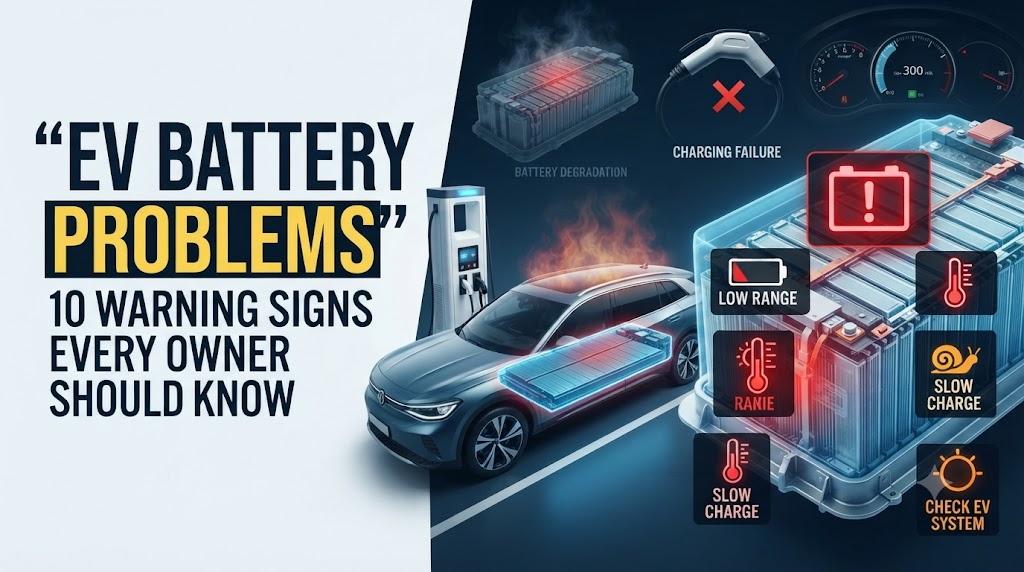
Issue Problem
EV Battery Problems can show up as decreased range, slow charging, sudden battery percentage drops, overheating warnings, or failure to charge. Of course, battery performance varies with age but sudden change should not be ignored.
The Battery Management System (BMS) constantly checks battery temperature, voltage, and charging conditions. It might tell the driver to be aware of an abnormality with a warning on the dash.
Symptoms: 10 Warning Signs
The Warning signs of Common EV Battery Problems are:
- The driving range suddenly drops – after a full charge the car can do fewer kilometers.
- Rapid battery drain – Battery percentage drops quickly and abnormally.
- Slow charging – Much longer than usual charging time.
- Charging failure – The vehicle cannot be started or charged.
- Battery warning light – A light on the dash warns you of a battery problem.
- Overheating warning – The car has reported high battery temperature.
- Decreased performance – Acceleration or available power may be limited.
- Unstable battery percentage – The shown percentage suddenly increases or decreases.
- Intermittent charging – Charging starts and stops for no apparent reason.
- Smoke, strange smell or visible damage – these should be inspected by a professional as soon as possible.
EV Battery Issues don’t cause every symptom. EV performance can also be impacted by weather, tyres, charging equipment, software and other electrical components.
What Might Be Going On
There are many reasons EV Battery Problems can occur. The most frequent causes are: Aging of the battery. Quicker degradation can be caused by frequent fast charging at high power, long periods of time spent at very high or low charge levels, and repeated exposure to extreme temperatures.
Other causes are damaged battery modules, wiring faults, cooling-system problems, BMS faults, damage to the charging port, onboard charger problems and software problems.
Extreme heat or cold can temporarily limit range and charging speed. That doesn’t always mean that the battery is damaged forever.
Diagnosis.
To diagnose problems with EV batteries correctly, you should seek the services of a trained EV technician or an authorized service center.
BMS fault codes, battery condition, diagnostic scan info you can get. Technicians can verify:
- Battery State of Health (SOH)
- Single cell or module voltage
- Temperature of the battery
- Charge history
- BMSdata
- Insulation related faults
- Charging system output
Before jumping to EV Battery Problems check simple possibilities like the charging cable, charging station and charging port. Verify whether the car requires a software update.
Never open or attempt to repair a high voltage battery.
Solutions.
The solution to EV battery problems depends on the real cause. Sometimes you can fix software problems by updating or resetting the system. The sensor, connector, cooling part, 12-volt battery or charging cable may need replacing.
Depending on the design of the vehicle, if there is significant degradation of the battery, the manufacturer may recommend replacement of individual modules or entire battery packs.
Cooling-system problems must be fixed quickly, because battery performance and safety rely on proper temperature control.
Repair Costs
Depending on the version of the EV and the part that is faulty, the cost to fix EV Battery Problems can be quite different.
A basic diagnostic check can cost anywhere between a few hundred to a few thousand rupees. Usually replacing a sensor, connector or 12-volt battery is much cheaper than replacing the high voltage battery pack.
In India, depending on the size of the battery, the vehicle model, the warranty and the repair method, replacing a high voltage battery can cost tens of thousands to several lakh rupees.
Before you approve expensive EV Battery Problems repairs, get a detailed estimate from the service center and see whether the battery is still under warranty.
Preventive
Good charging and maintenance habits can minimize the risk of EV Battery Problems. Stay out of the extreme heat if you can, and follow the charging recommendations of the manufacturer.
Fast charge when you need it but don’t make high-power fast charging your only charging practice if the manufacturer recommends otherwise.
Don’t drain the battery to very low levels on a regular basis. Update the vehicle’s software and monitor the cooling system.
If the car has been in a serious accident, have the battery professionally checked before charging it or driving it.
Routine inspections can help find EV Battery Problems before they get expensive.
FAQs
1. What are the most common EV battery issues?
Typical EV battery problems include range reduction, slow charging, charging failure, overheat alerts, battery warning lights and diminished vehicle performance.
2. How long do EV batteries live?
Battery life varies by vehicle, climate, usage, and charging habits. While many manufacturers offer long battery warranties, owners should verify the specific warranty terms and conditions for their vehicle.
3. Are EV battery problems fixable?
“Yeah. Some EV Battery Problems are related to software, sensors, wiring, cooling systems or individual battery modules and may be repairable. If the battery is badly damaged you may have to replace it.
4. Can fast charging damage an EV battery?
Charging quickly and often at high power can raise the temperature of the battery and cause it to deteriorate faster as time goes on. Modern EVs use battery management systems to regulate temperature and charging.
5. What do I do if I get a battery warning?
If your car gives a battery warning, check your owner’s manual and call a qualified technician. If there is smoke, fire, extreme heat or physical battery damage, move away from the vehicle when safe to do so and call for professional emergency assistance.
Disclaimer
This article on EV Battery Problems is for general informational purposes only. Various EV models have different repair procedures and battery technology. Do not open, alter or repair a high-voltage battery yourself. Always follow the manufacturer’s instructions and consult an authorized or qualified EV technician for diagnosis and repair.
Also read:
Brake Problems: Warning Signs, Causes, Diagnosis, Solutions & Cost
E20 Petrol Problems: Mileage & Engine Life Explained
Why Does My Car Vibrate While Driving?
Maruti Suzuki Brezza 2026: कीमत, माइलेज, फीचर्स और लॉन्च डेट – क्या यह बनेगी 2026 की सबसे बेस्ट SUV?