
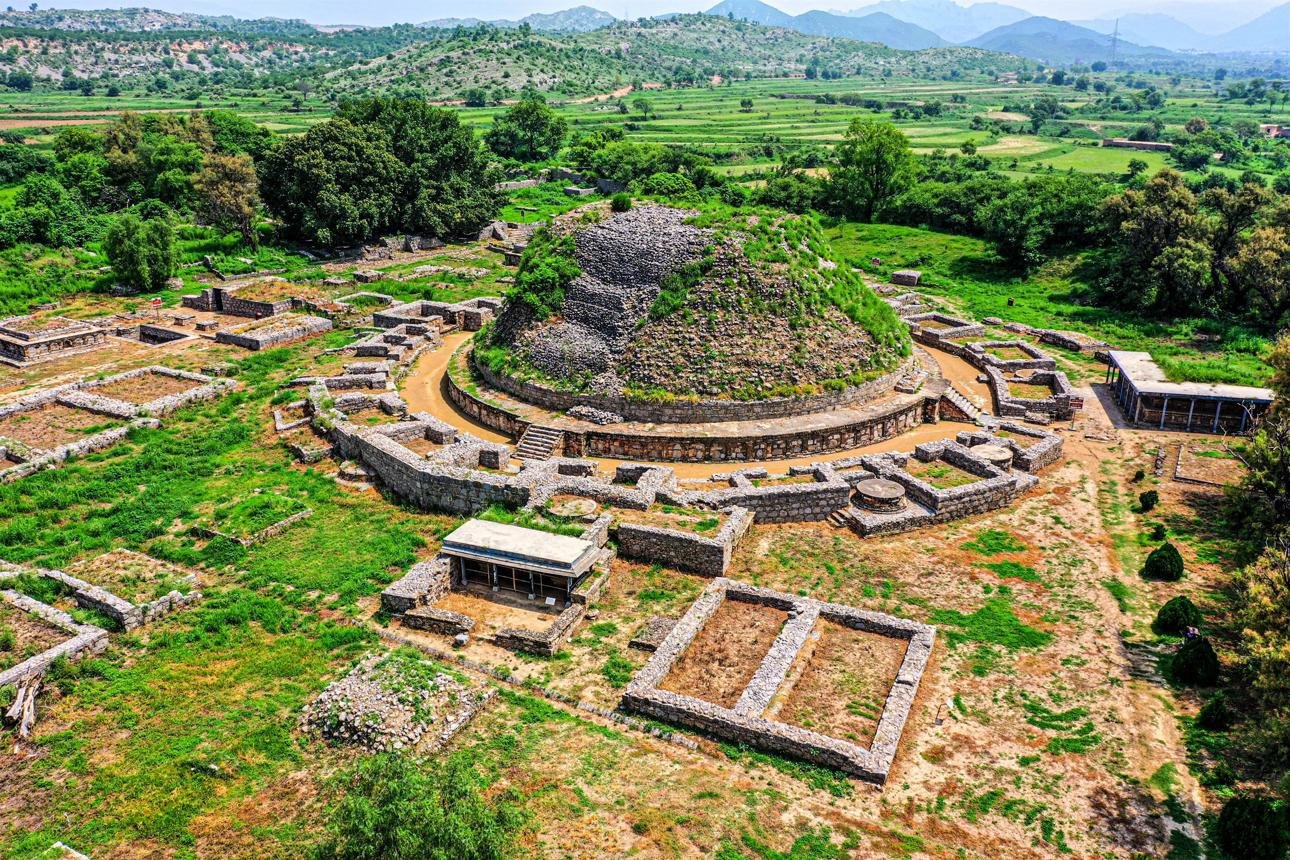
UNESCO has raised worries regarding the restoration process of Taxila, stating that wrong methods of conservation can spoil this ancient archaeological site. Find out what the importance of Taxila is and what this controversy is all about.
Taxila UNESCO Warning
UNESCO has apparently expressed concerns over restoration work in Pakistan, drawing international attention to the ancient city of Taxila, a UNESCO World Heritage site and one of the world’s oldest educational centers.
Media reports say UNESCO is concerned some of the repair work may not meet internationally accepted conservation standards. Heritage experts fear that replacing or covering the original archaeological remains with modern construction materials will forever alter the historical authenticity of the site.
The question has sparked a debate among archaeologists, historians and conservation professionals, asking an important question: Can restoration meant to preserve history, inadvertently erase it?
What is Taxila?
It is an archaeological site of South Asia which is located near Islamabad in present-day Pakistan.
For hundreds of years, the city flourished and became the center of education, civilization, trading, and religion. Centuries ago, even before there were modern universities, Taxila attracted people from all across Asia to study various subjects like:
Philosophy
Medical Sciences
Mathematics (Maths)
Grammar
Political Science
Military Strategy
Astronomy.
Apart from education, it was also an important communication center between civilizations by way of trade and civilization.
Present day archaeological site includes many ancient monasteries, temples, stupas, residential sites, and other remains of various civilizations.

why should UNESCO be worried?
Some restoration practices being used at parts of the Taxila archaeological complex have reportedly been questioned by UNESCO.
The organization is not concerned about conserving the site itself, which it supports on conservation grounds, but how it is conserved.
The experts reportedly flagged issues including:
- Modern cement and construction materials.
- Modification of original archaeological structures
- Restoration practices not conforming to international heritage standards.
- Risk of losing the historic authenticity of the site.
For the archaeologist all original bricks, stones and walls are valuable pieces of historical evidence. Once replaced or greatly altered, that evidence can be gone forever.
Why Real Conservation Is Important
Renovating an ancient monument is a very different thing than renovating a modern building.
Conservation is not about making historic buildings look like new. Instead, it is to stabilise them, whilst keeping as much of the original material as possible.
Principles of international conservation emphasize:
- Light touch.
- Documentation scientifique.
- Original architecture preserved.
- Use reversible restoration techniques where possible.
- Respect for historical accuracy.
With this approach, future generations will be able to study and understand monuments in their original historical context.

Debate Over Contemporary Building Materials
One of the main points of discussion is the reported use of modern cement in the restoration.
Conservation experts often warn against the over-reliance on modern materials, because they can:
Damage to Ancient Buildings
Modern cement is different from traditional building materials and can trap moisture or stress in old masonry.
Less archaeological value
It can cover original surfaces making future archaeological studies more difficult.
Change the Historic Look
The replacement of historic features with modern materials can alter the original architectural character of the site.
Make Irrevocable Change
It is very difficult when the true materials are taken away or hidden to restore the place to what it was.
Why Taxila Is a World Heritage Treasure
Taxila is not just an archaeological site, it is thousands of years of human civilisation.
The city was influenced by several cultures such as:
- Persian Empire (Achaemenid)
- The Greek Civilization after Alexander the Great
- Maurya Empire (Taxila UNESCO Warning)
- Indo-Greek Kingdom
- Kushan Kingdom (Taxila UNESCO Warning)
- Buddhist civilisations
Its monuments show the traces of centuries of cultural exchanges, artistic evolution and religious history.
It is for this outstanding importance that Taxila was included in the World Heritage List by UNESCO in 1980.

The role of UNESCO in safeguarding heritage
UNESCO works with governments and heritage authorities to protect sites of outstanding universal value.
When concerns arise, UNESCO can:
- Expert evaluations.
- Request technical reports.
- Advise on better conservation practices
- [ ] Check on restoration projects.
- Promote adherence to international conservation standards.
The measures are intended to safeguard heritage sites, not to prevent their restoration altogether.
What’s the big deal about Pakistan?
Taxila is in Pakistan, but its significance transcends the country’s borders.
It is a familiar page in the history of human civilization.
Every archaeological find at Taxila helps researchers to better understand:
- Old systems of education.
- City planning.
- Trade routes;
- religious development
- Architecture…
- Exchanges in Asia. Cultural exchanges.
It is our responsibility to protect the site so that future generations can continue to learn from this priceless historical record.
Preservation and Restoration in Balance
Weather, earthquakes, pollution and human activity all contribute to the natural deterioration of historic monuments. Often restoration is required to prevent further damage.
But conservation experts stress that restoration should always be guided by:
- Historical fidelity.
- Scientific study.
- International Principles of Conservation.
- Long term conservation.
- Protection of original materials where feasible.
One of the greatest challenges in heritage conservation is to find the right balance between structural stability and authenticity.
Summary (Taxila UNESCO Warning)
The Taxila UNESCO Warning has highlighted the challenges in protecting ancient heritage sites on a global scale. Monuments need to be restored to prevent them from falling into ruin, but experts warn that this must be done carefully so that the historical authenticity is not destroyed.
Taxila, a UNESCO World Heritage site and an irreplaceable cultural treasure, is among the world’s oldest learning centers. It is not the responsibility of one nation to preserve it, but a shared commitment to protect the collective history of mankind.
The ongoing discussions between UNESCO and the relevant authorities highlight the need to make sure conservation efforts are able to safeguard the original character of the site while securing its future for generations to come.

FAQs
What makes UNESCO worried about Taxila?
Unesco has expressed concern that some restoration work has not fully complied with internationally recognised conservation standards, aimed at preserving the authenticity of the site.
What is the importance of Taxila in history?
Taxila was one of the great learning centres of the ancient world and contains archaeological remains of several civilisations over a number of centuries.
Is Taxila a World Heritage Site of UNESCO?
Yes. Taxila was declared a UNESCO World Heritage Site in 1980 because of its exceptional historical and cultural importance.
Is Taxila at risk of losing its World Heritage status?
The present reports are concerning UNESCO conservation. Such concerns do not necessarily mean that a site will lose its World Heritage status. Typically, UNESCO works with authorities to improve preservation methods.
Why do authentic restorations?
Genuine restoration preserves original historical materials and archaeological evidence and maintains the cultural and educational value of heritage sites for future generations.
EV Range Claim Court Case: Why the Court Ruled Against the Customer Despite Lower Driving Range
गलती से 5W-20 ऑयल डाल दिया जबकि 5W-30 चाहिए था? यहाँ 10 आसान पॉइंट्स और सही तरीके (Simple Hindi में)