
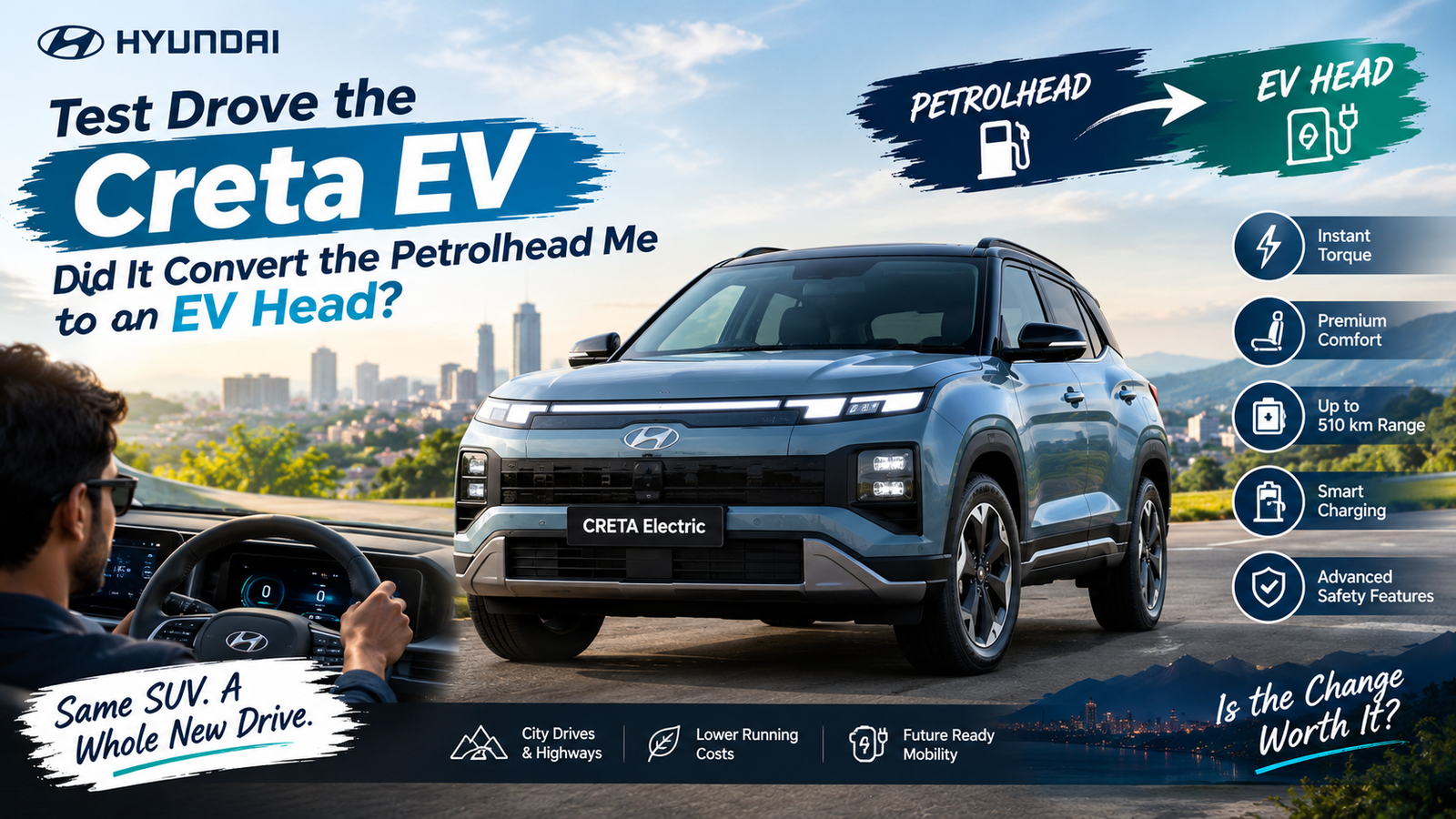
Read this Hyundai Creta EV test drive review to discover its acceleration, driving experience, range, charging, comfort, and whether it can win over a petrolhead.
Table of Contents
Hyundai Creta EV Test Drive Review
The Hyundai Creta EV Test Drive Review raises an interesting question: can an electric SUV convince someone who genuinely enjoys petrol-powered cars to embrace electric mobility?
The Hyundai Creta Electric combines the familiar design and practicality of the popular Creta with an electric powertrain. It offers two battery options, modern features, and a claimed range of up to 510 km, depending on the variant. But specifications alone cannot tell us whether an EV feels exciting behind the wheel.
First Impressions: Familiar Creta, Different Personality
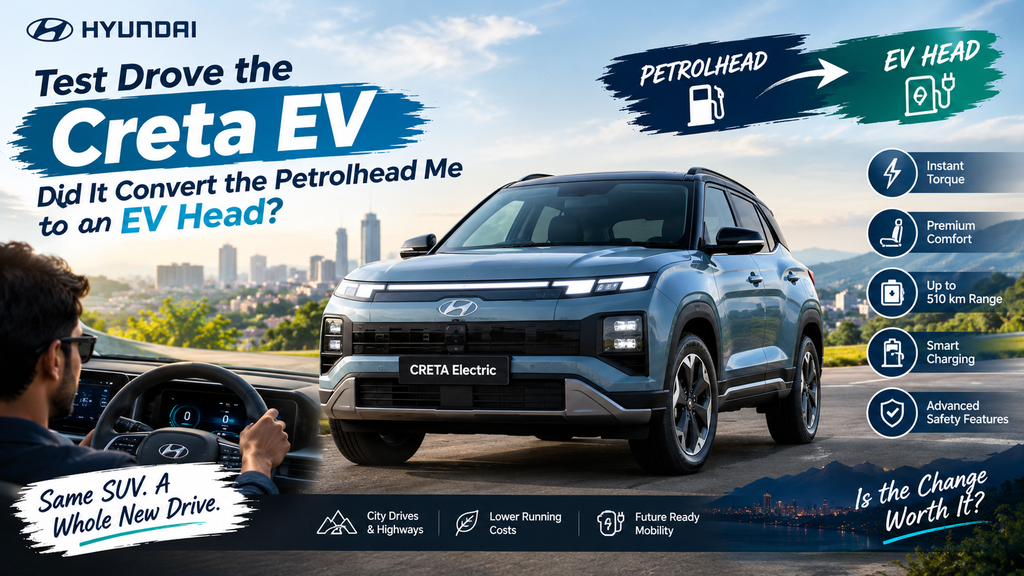
The first thing that makes the Creta Electric approachable is its familiar SUV shape. It does not feel like a completely different vehicle designed only for electric-car enthusiasts. Instead, it retains the practical character of the regular Creta while adding EV-specific styling, including a closed front grille, pixel-inspired details, and aerodynamic alloy wheels (Hyundai Creta EV Test Drive Review).
For someone moving from a petrol car, this familiarity matters. The elevated driving position, spacious cabin, and everyday usability make the transition to an electric SUV less intimidating.
Inside, the cabin features digital displays, ventilated front seats, connected technology, and a feature-rich layout. The boot offers 433 litres of space, with an additional 22-litre storage compartment under the bonnet, making it practical for everyday family use.
Performance: Can an EV Excite a Petrolhead?
This is where the Hyundai Creta Electric starts making its strongest argument. Unlike a petrol engine that builds power as the revs rise, an electric motor delivers torque almost immediately. The result is quick, smooth acceleration without gear shifts interrupting the experience.
The Long Range version produces up to 171 hp and 255 Nm of torque. Hyundai claims a 0–100 km/h time of around 7.9 seconds, making it quick enough to feel lively during overtaking and city driving. Eco, Normal, and Sport modes let the driver choose between efficiency and sharper responses.
However, petrolheads may miss the sound of an engine revving and the mechanical character of a conventional powertrain (Hyundai Creta EV Test Drive Review). The Creta EV replaces those sensations with instant response and quiet confidence.
My takeaway: electric performance may not reproduce the emotion of a petrol engine, but it can deliver a different kind of excitement.
Driving Experience: Silence, Comfort and Control
One of the biggest changes when driving an EV is the silence. Without engine noise or traditional gear changes, the cabin feels calmer, especially in traffic (Hyundai Creta EV Test Drive Review). Acceleration is smooth, and regenerative braking helps slow the vehicle while recovering energy.
The Creta Electric also offers multiple regeneration settings and an i-Pedal mode, allowing drivers to manage acceleration and deceleration with less frequent use of the brake pedal.
Its suspension is firmer than the petrol Creta’s to manage the battery’s additional weight, and the steering feels heavier at low speeds. Even so, the car remains composed and confident at higher speeds, according to Autocar India’s road test.
For a driver who enjoys responsive handling, the Creta EV is more than a quiet city vehicle. However, the best way to judge its ride quality is to test it on the roads you use every day.
Range and Charging: The Real EV Test
Range anxiety is often the biggest concern for petrol-car owners considering an electric vehicle (Hyundai Creta EV Test Drive Review). Hyundai lists a claimed range of up to 510 km for the Long Range version, while the smaller battery option has a claimed range of up to 420 km under the updated figures. Actual distance depends on traffic, speed, air-conditioning use, driving style, and weather.
Before buying, consider three things:
- Daily commute: Estimate how many kilometres you normally drive.
- Home charging: Check whether you can install a suitable charger where you park.
- Long journeys: Check charging locations along your regular highway routes and allow time for charging stops.
If most of your driving is within the city and you can charge at home, the Creta EV could be convenient. If you frequently take long, unplanned highway trips, charging infrastructure and journey planning deserve more attention.
Price and Ownership: Is the Switch Worth It?
The Creta Electric’s standard ex-showroom price range has been listed at approximately ₹18.03 lakh to ₹23.82 lakh, although prices and offers can change. Hyundai also introduced a Battery-as-a-Service (BaaS) option starting at ₹10.99 lakh, with battery usage charged separately from ₹3.90 per kilometre. Buyers should compare the complete cost of ownership rather than looking at the starting price alone.
An EV can reduce routine powertrain maintenance and energy costs, particularly when charged at home. However, the actual savings depend on electricity tariffs, public charging costs, annual mileage, insurance, and the purchase or battery-rental arrangement.
FAQs
1. Is the Hyundai Creta EV good for petrol-car owners?
Yes. Its familiar SUV layout, smooth acceleration, and everyday practicality can make the transition easier for drivers accustomed to petrol cars (Hyundai Creta EV Test Drive Review).
2. What is the claimed range of the Hyundai Creta Electric?
The updated claimed range is up to 420 km for the smaller battery and up to 510 km for the Long Range version. Real-world range varies.
3. Is the Creta EV fun to drive?
Its instant torque and responsive acceleration make it enjoyable, although it does not offer the engine sound or gear changes that some petrol enthusiasts love.
4. Should I buy the Creta EV for highway travel?
It can work for highway journeys, but check charging availability along your routes and allow time for charging stops.
Conclusion: Did It Convert a Petrolhead into an EV Head?
The Hyundai Creta Electric makes a convincing case for electric mobility. It combines familiar SUV practicality with quick acceleration, a quiet cabin, modern features, and a claimed range that can suit many daily driving needs.
Would it convert every petrolhead? Probably not. Some drivers will always love the sound and character of an internal-combustion engine. But if you value performance, refinement, and everyday convenience, the Creta EV could make you rethink what makes a car enjoyable (Hyundai Creta EV Test Drive Review).
The final verdict: one test drive might not erase a petrolhead’s love for engines, but it could certainly open the door to electric driving.
Also read-
Maruti Suzuki Brezza 2026: कीमत, माइलेज, फीचर्स और लॉन्च डेट – क्या यह बनेगी 2026 की सबसे बेस्ट SUV?
Toyota Glanza V(O) variant 2026: Price, Features & Is It Worth Buying?
Triumph Speed 400 Latest Updates 2026: Price, Features & Specs
Best Litre-Class Motorcycles in India: Which One Would You Choose?