
Autonomous Vehicles
In today’s digital age, Artificial Intelligence (AI) isn’t just limited to smartphones, chatbots, and recommendation systems. Autonomous vehicles (self-driving cars) are using AI in the most exciting and useful way.
Autonomous vehicles, or smart vehicles, can make decisions on their own, understand the road, find obstacles, and get to their destination safely without a human driver. Ye sab AI, Machine Learning, sensors, aur real-time data processing ke milne se mumkin hota hai.Aaj ke digital yug mein Artificial Intelligence (AI) sirf smartphones, chatbots ya recommendation systems tak simit nahi raha. AI ka sabse romanchak aur impactful upyog autonomous vehicles (self-driving cars) mein ho raha hai. Autonomous vehicles aise smart vehicles hote hain jo bina human driver ke khud decision le sakte hain, road ko samajh sakte hain, obstacles ko detect kar sakte hain aur safely apni destination tak pahunch sakte hain. Ye sab mumkin hota hai AI, Machine Learning, sensors aur real-time data processing ke combination se.
Many tech and car companies around the world, like Tesla, Waymo (which is part of Google), and Uber, are working quickly on self-driving technology. The goal of these companies is to make driving safer and more efficient, reduce road accidents, and improve traffic flow.
The Basic Idea Behind Autonomous Vehicles
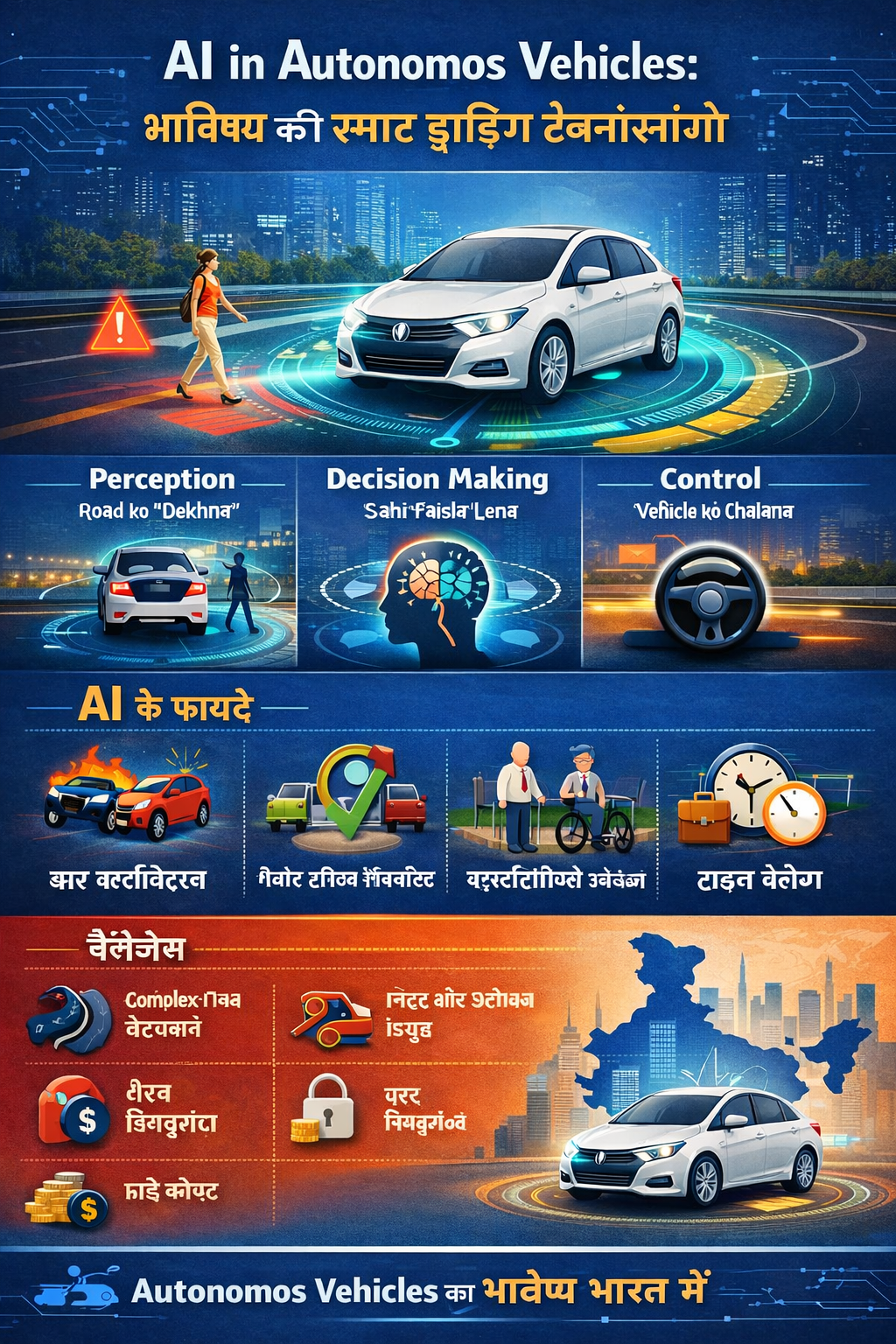
Autonomous vehicles use sensors, cameras, radar, LiDAR (Light Detection and Ranging), and GPS to understand their surroundings. Ye data AI algorithms ko diya jata hai jo real-time mein decision lete hain — jaise kab brake lagana hai, kab turn lena hai, ya kab speed kam/zyada karni hai.
This process can be broken down into three main steps:
- Understanding the environment
- Making Decisions (Sahi faisla lena)
- Control (Driving the vehicle)
AI works like a brain between these three steps.
Perception: “Seeing” and “understanding” the road
AI-powered self-driving cars use cameras and sensors to collect data and then analyze it to find road signs, traffic lights, pedestrians, other cars, and obstacles. Computer Vision and Deep Learning models help with this.
For example, if a pedestrian suddenly starts crossing the road, the AI system instantly recognizes them and decides to brake, just like a human driver would, but with a faster reaction time.
Making Decisions: Making Smart Choices Right Now
AI algorithms do second hazaron calculations. Ye system traffic rules, road conditions, aur aas paas ki gaadiyon ke behavior ko dekh kar sabse accha faisla karta hai.
Machine learning models learn from past driving data. The more data you have, the more accurate it will be. Because of this, self-driving cars get smarter over time.
Control: Safe and Smooth Driving
AI system controls steering, acceleration, and braking. Ye sab commands vehicle ke control system tak pahunchte hain, jo physical movement ko execute karta hai.
High-performance computing platforms, like NVIDIA’s AI chips that help with real-time processing, play a big role here.
AI ke Fayde Self-Driving Cars mein
1. Fewer accidents on the road
Human error is the main cause of road accidents, like being distracted, tired, or driving too fast. AI system na thakta hai, na distracted hota hai. Isse accidents ki sambhavana bahut kam ho jati hai.
2. Managing traffic
AI traffic patterns ko dekh kar sabse achhe raste batata hai, jo traffic jams ko kam karte hain aur fuel efficiency ko badhate hain.
3. Easy to get to
Self-driving cars can be very helpful for people who can’t drive, like the elderly, disabled, or blind.
4. Saving time
You can use your time more wisely instead of driving, because the vehicle will drive itself.
Jo abhi bhi maujood hain, challenges hain.
There are many benefits to AI-based self-driving cars, but there are also some problems:
1. Difficult road conditions
AI has a hard time with unpredictable traffic, animals, pedestrians, and road rules that aren’t always followed in countries like India.
2. Legal and Moral Problems
Who will be responsible if an accident happens: the car maker, the software developer, or the passenger? Ye abhi bhi vichar karne ka vishay hai.
3. Protecting Data
Self-driving cars collect a lot of data. It is very important to keep this data safe.
4. Expensive
Because of advanced sensors and AI systems, these cars are still very expensive.
The Future of Self-Driving Cars in India
Fully autonomous vehicles are not yet common in India, but AI-based driver assistance features like lane assist, automatic braking, and adaptive cruise control are becoming more and more popular. In the future, when infrastructure and rules are better, more people may start using self-driving cars.
Smart cities and intelligent traffic systems can work together with AI-driven vehicles to create a connected ecosystem where vehicles can talk to each other and traffic signals.
Final Thoughts
AI autonomous vehicles are turning from a futuristic idea into a reality. Ye technology safar ko zyada achha, samajhdar aur asan banane ki kshamta rakhti hai. There are still some problems to solve, but given the speed of research and innovation, it wouldn’t be wrong to say that self-driving cars could be common in the next 10 to 15 years.
AI is not just driving cars; it is also changing the future of transportation.
Also read: Toyota Urban Cruiser EBELLA: 7 Amazing Features, Price, Range & Launch Date in India
Read this: Mercedes-Benz G-Class (G-Wagon): History, Features & Why It’s So Popular
ALSO READ: Unraveling DTC Code P0113 Intake Air Temperature Sensor 1 Circuit High
ALSO READ: Fixing P0016 in Skoda, VW, and Audi: A Step-by-Step Diagnosis