
Fuel Gauge vs DTE explained in simple terms. Learn how to read your car’s fuel level, understand distance to empty and know when to refuel safely.
Table of Contents
Introduction (Fuel Gauge vs DTE)
Have you ever driven your car and wondered whether to trust the fuel gauge or the Distance to Empty (DTE) display? Modern cars provide both indicators to help drivers understand how much fuel remains. However, these readings do not always tell the complete story.
Understanding Fuel Gauge vs DTE can help you plan fuel stops, avoid unexpected breakdowns and reduce the risk of running out of fuel during a journey.
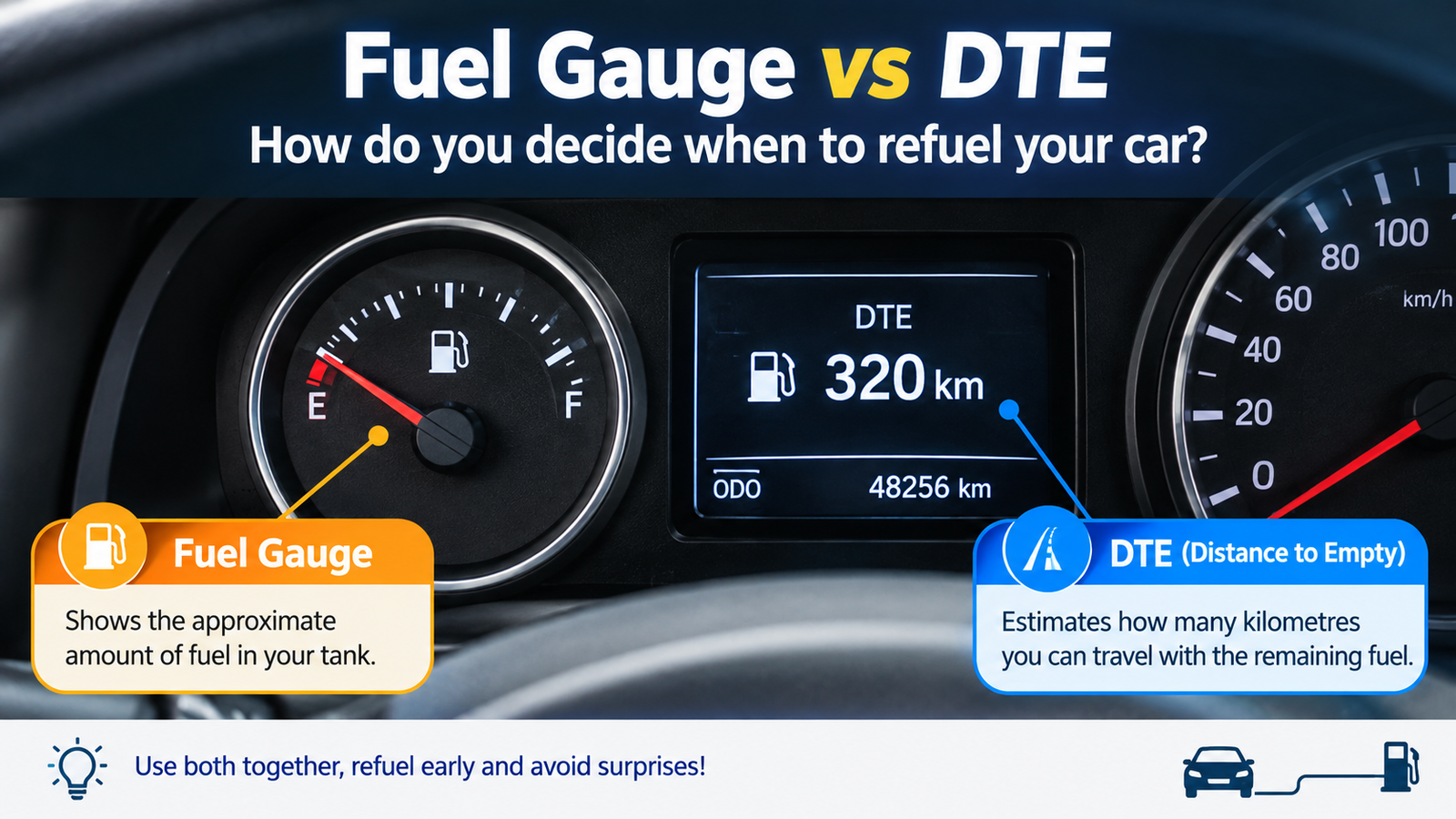
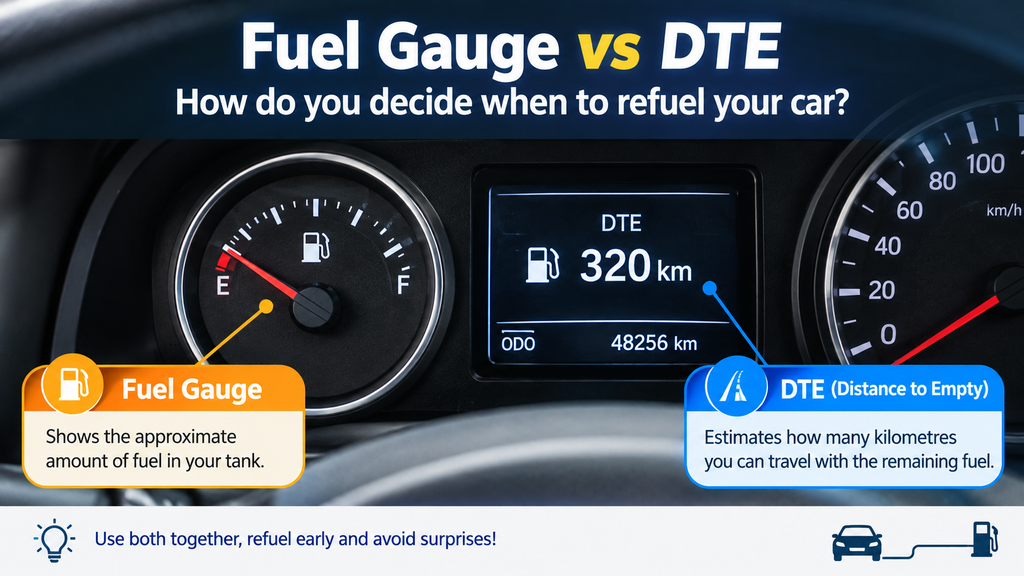
The fuel gauge shows the approximate amount of fuel in the tank, while DTE estimates how far your car can travel before the remaining fuel runs out. Knowing how to use both indicators is essential for everyday driving (Fuel Gauge vs DTE).
1. What Is a Fuel Gauge?
The fuel gauge is the instrument on your dashboard that indicates the fuel level in your tank. It usually displays markings such as F (Full), half and E (Empty).
When the needle approaches E or the low-fuel warning light appears, it means you should look for a petrol pump or diesel station.
However, the fuel gauge is not always perfectly precise. The reading can change slightly when driving uphill, downhill or around sharp corners because fuel moves inside the tank.
2. What Is DTE in a Car?
DTE stands for Distance to Empty. It estimates how many kilometres your car can travel using the fuel remaining in its tank.
For example, if your dashboard displays DTE 80 km, the car estimates that approximately 80 kilometres of driving remain under its current calculation.
The estimate depends on recent fuel consumption, driving style, traffic, road conditions and air-conditioning use. Therefore, the actual distance may be lower than the displayed figure.
3. Fuel Gauge vs DTE: Key Differences
| Feature | Fuel Gauge | DTE |
|---|---|---|
| What it shows | Approximate fuel level | Estimated remaining distance |
| Display | Needle or fuel bars | Kilometres |
| Main purpose | Check remaining fuel | Plan refuelling stops |
| Accuracy | Approximate | Depends on driving conditions |
| Main limitation | May not show exact fuel quantity | Estimated range can change quickly |
When comparing Fuel Gauge vs DTE, remember that neither display guarantees exactly how much driving you can complete before the tank becomes empty (Fuel Gauge vs DTE).
4. When Should You Refuel Your Car?
It is better to refuel before your tank reaches a critically low level. As a general rule, consider visiting a fuel station when your tank reaches around one-quarter full, particularly before long trips.
You should refuel earlier when:
- You are travelling through remote areas.
- Fuel stations are widely spaced.
- You are driving in heavy traffic or mountainous regions.
- Your low-fuel warning light has appeared.
- DTE is dropping quickly or showing a very low range.
Do not wait for the DTE display to reach zero before looking for fuel.
5. Why Does DTE Sometimes Drop Quickly?
DTE is calculated using estimated fuel consumption. If you suddenly encounter traffic, climb steep roads, drive at high speeds or use the air conditioner heavily, your fuel consumption may increase.
As a result, a displayed range of 100 km might fall faster than expected.
This is why Fuel Gauge vs DTE should not be treated as a competition between two perfectly accurate measurements. Use both together and keep a safety margin.
6. Tips to Avoid Running Out of Fuel
- Refuel before starting a long journey.
- Check fuel levels before entering highways or remote areas.
- Maintain steady speeds and avoid unnecessary acceleration.
- Use your navigation app to locate nearby fuel stations.
- Never rely entirely on the DTE number.
- Follow your vehicle manufacturer’s guidance for fuel warnings.
These simple habits can make driving more convenient and help you avoid unnecessary roadside stops.
Frequently Asked Questions (FAQs)
1. What does DTE mean in a car?
DTE means Distance to Empty. It estimates how far your car can travel with the fuel remaining in the tank.
2. Which is more accurate: the fuel gauge or DTE?
Both are estimates with different purposes. The fuel gauge indicates the approximate fuel level, while DTE estimates the remaining driving distance.
3. Should I drive when DTE shows 20 km?
It is safer to refuel as soon as practical rather than relying on the remaining 20 km. Actual range may be shorter than estimated.
4. Does driving style affect DTE?
Yes. Speed, acceleration, traffic, road gradients and air-conditioning use can affect fuel consumption and change the DTE estimate.
5. Is it safe to drive with the low-fuel warning light on?
You may have some fuel remaining, but the amount and distance vary by vehicle. Refuel promptly instead of continuing to drive on a low tank.
Conclusion
Understanding Fuel Gauge vs DTE helps you make better refuelling decisions. The fuel gauge indicates the approximate amount of fuel left, while DTE estimates how far you might travel before running out.
For safer driving, use both displays, refuel before the tank becomes critically low and plan fuel stops before long journeys. A little preparation can help you avoid unexpected delays and enjoy a more stress-free drive.
Disclaimer: Fuel readings and DTE calculations vary by vehicle and driving conditions. Always follow your owner’s manual and refuel promptly when the low-fuel warning appears.
Also read-
Rented Mercedes A200 :Frankfurt Trip, Ganpati Aarti & Mercedes A200 Rental Experience
Volvo NVIDIA Automated Driving Partnership
Tata Sierra EV vs Curvv EV: Why I Chose the Sierra
MG Astor Replacement 2027 in India; New SUV Expected in 2027
Maruti Suzuki Brezza 2026: कीमत, माइलेज, फीचर्स और लॉन्च डेट – क्या यह बनेगी 2026 की सबसे बेस्ट SUV?