
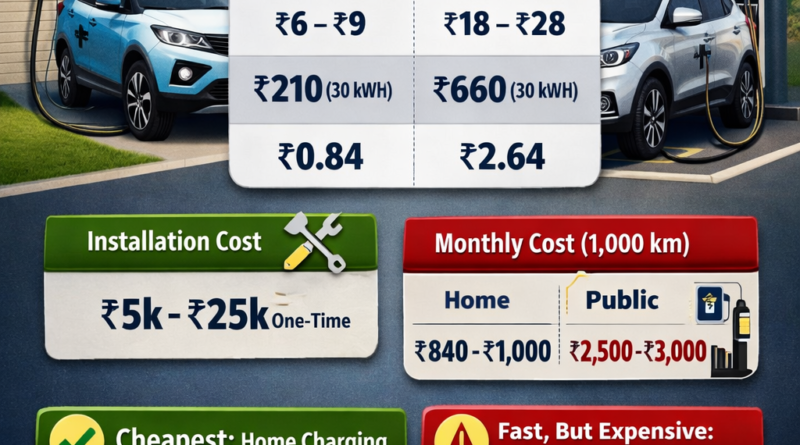
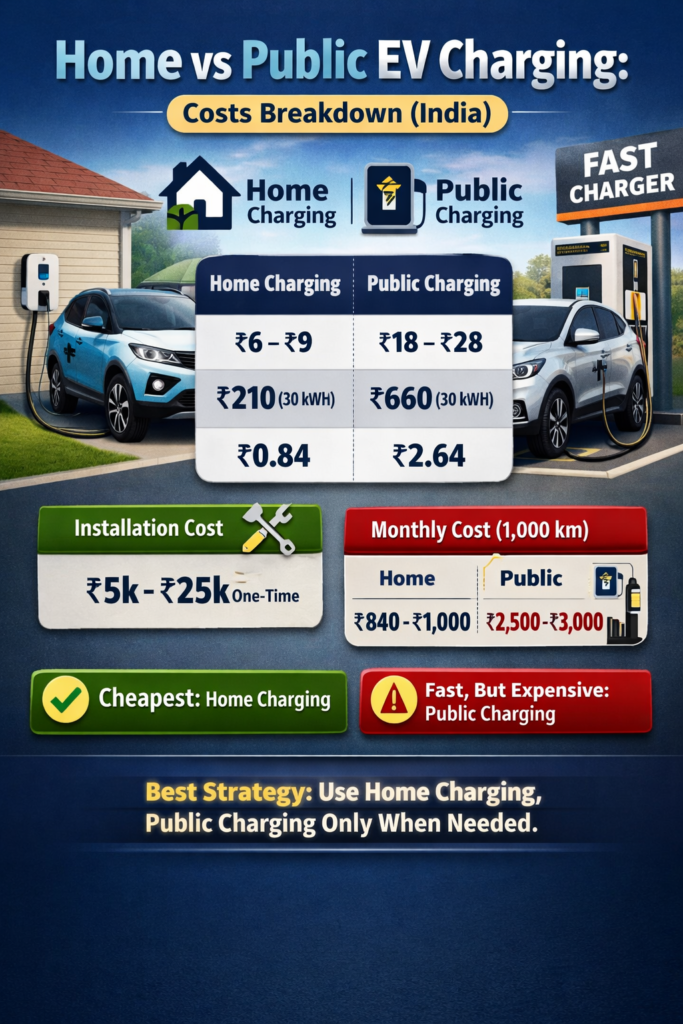
Home vs Public EV Charging: Costs Breakdown (India)
Home vs Public EV Charging: Electric vehicles are rising fast in India, and one big question every new EV owner asks is: Is home charging cheaper than public charging?
The short answer is yes—but the full picture depends on electricity tariffs, charger type, city, and your driving pattern.
This guide breaks down the real costs of charging your EV at home vs public stations, with practical examples for Indian users.
What Is Home EV Charging (Home vs Public EV Charging)?
Home charging means installing a private charger at your residence and charging your EV using your domestic electricity connection. Most EV owners in India use:
- A standard 15A socket (slow charging)
- A dedicated wall box charger provided by the manufacturer
Popular EVs like Tata Nexon EV, MG ZS EV, and Tata Tiago EV come with home charging solutions.
What Is Public EV Charging (Home vs Public EV Charging)?
Public charging stations are installed at malls, highways, offices, and fuel stations. These include:
- DC fast chargers (30 kW–60 kW+)
- AC chargers (slower than DC but faster than home sockets)
You’ll find them via apps like Tata Power EZ Charge and Statiq across cities and highways (Home vs Public EV Charging).
Cost Per Unit (kWh) in India (Home vs Public EV Charging)
| Charging Type | Cost per kWh (Approx) | Charging Speed | Where Used |
|---|---|---|---|
| Home Charging | ₹6 – ₹9 | Slow–Medium | Overnight / Daily |
| Public AC Charger | ₹12 – ₹18 | Medium | Parking areas |
| Public DC Fast Charger | ₹18 – ₹28 | Very Fast | Highways / Malls |
Real Example: 30 kWh Battery EV
Let’s assume your EV has a 30 kWh battery (common in mid-size EVs).
✅ Home Charging Cost
- 30 kWh × ₹7 = ₹210 for full charge
- Range ≈ 250 km
- Cost per km ≈ ₹0.84
❌ Public DC Fast Charging Cost
- 30 kWh × ₹22 = ₹660
- Same range ≈ 250 km
- Cost per km ≈ ₹2.64
👉 Public fast charging can be 3× more expensive than home charging (Home vs Public EV Charging).
Installation Cost for Home Charger
| Item | Approx Cost |
|---|---|
| Charger (often included with car) | ₹0 – ₹15,000 |
| Wiring & MCB | ₹3,000 – ₹8,000 |
| Installation | ₹2,000 – ₹5,000 |
One-time cost: ₹5,000 – ₹25,000
This cost is usually recovered within a few months compared to public charging expenses(Home vs Public EV Charging).
Time vs Money Trade-Off
| Factor | Home Charging | Public Charging |
|---|---|---|
| Time | 6–8 hours | 45–90 minutes |
| Cost | Very Low | High |
| Convenience | Charge while sleeping | Travel to station |
| Best For | Daily users | Emergency / Travel |
When Should You Use Public Charging?
Public charging makes sense when:
- You are on long highway trips
- You forgot to charge at home
- You live in an apartment without charging access
- You need a quick top-up
When Home Charging Is the Best Option
Home charging is ideal if:
- You have a dedicated parking spot
- You drive daily within city limits
- You want the lowest running cost
- You can charge overnight
Monthly Cost Comparison (1,000 km Driving)
| Charging Mode | Monthly Cost |
|---|---|
| Home Charging | ₹840 – ₹1,000 |
| Public Fast Charging | ₹2,500 – ₹3,000 |
Savings: ₹1,500–₹2,000 per month with home charging.
Battery Health Factor
Frequent DC fast charging heats the battery more and may reduce long-term battery health. Slow home charging is healthier for EV batteries (Home vs Public EV Charging).
Final Verdict
- Cheapest: Home charging
- Fastest: Public DC charging
- Best strategy: Use home charging daily, public charging only when needed
If you own or plan to buy EVs like Tata Nexon EV or Tata Tiago EV, installing a home charger is the smartest financial move.
Read this: Read this: Maruti Suzuki Brezza 2026 Complete Review Features Mileage & Price
Read this – Best Cars in India Under 10 Lakhs: All Details and features