
Explore how the move to electric vehicles is reshaping cars, infrastructure and consumer tastes, with growth in EV tech, batteries and charging.
Electrification of the automotive industry
Explore how the electrification of the automotive industry is transforming vehicles, infrastructure, and buyer choices with EV technology, batteries, and charging growth.
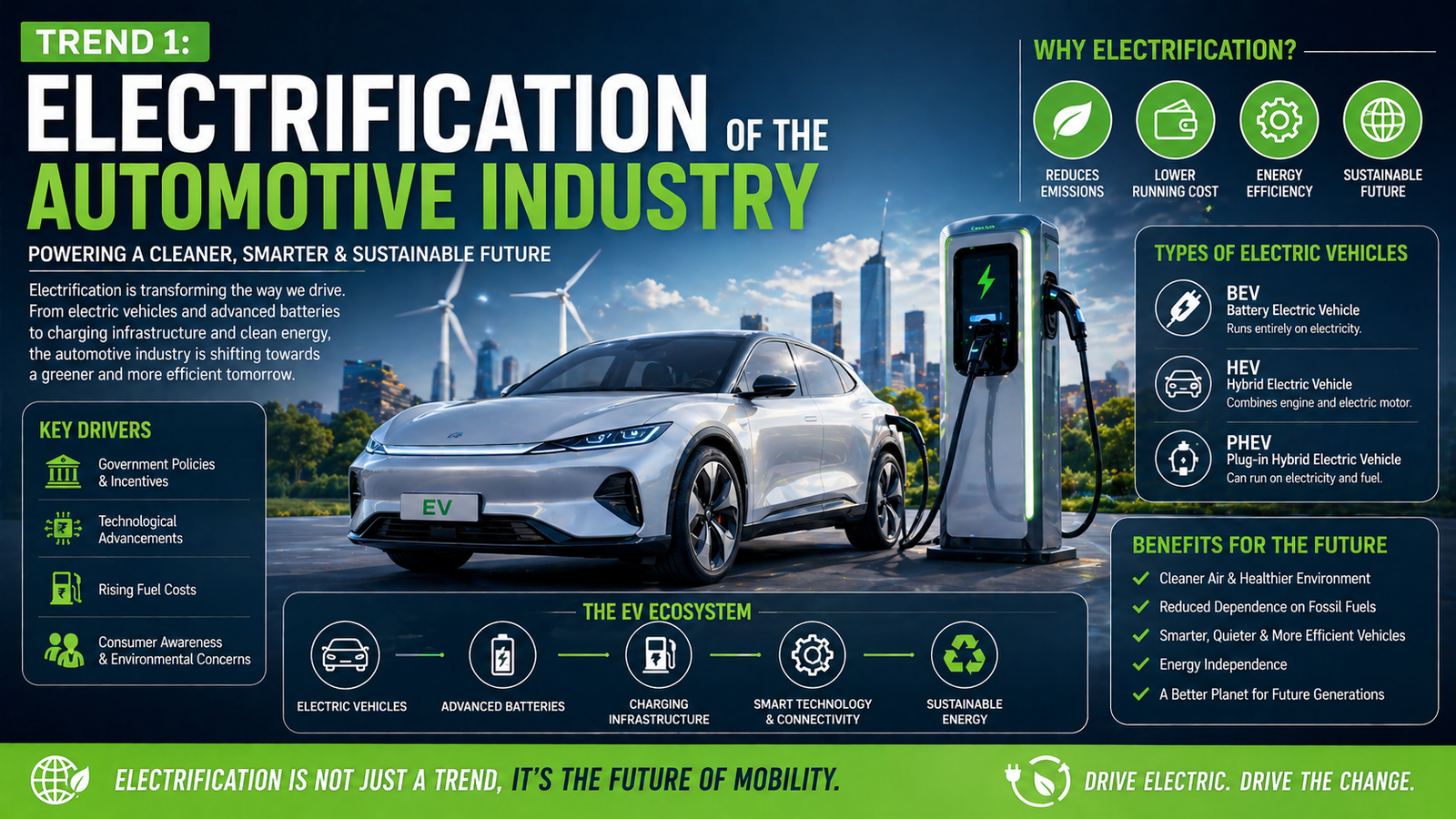
Trend 1. Electrification of the automotive industry
Electrification in the automotive industry is no longer a vision. It’s happening today. Governments, manufacturers, and consumers are all travelling in one direction, towards cleaner mobility powered by electricity rather than fossil fuels. EVs are rapidly going mainstream, from compact city cars to premium SUVs and commercial fleets.
India is spearheading this wave with firms such as Tata Motors, Mahindra & Mahindra, and MG Motor India providing pragmatic, affordable EV choices for the common buyer.
In this blog we talk about why electrification is the strongest trend shaping the future of mobility.
What Does Electrification Mean for Vehicles?
Electrification means replacing or supplementing conventional internal combustion engines (petrol/diesel) with electric powertrains. This includes:
- Battery Electric Vehicles (BEV)
- Hybrid electric cars (HEVs)
- Plug-in hybrid electric vehicles (PHEVs)
Of these, BEVs, or all-electric cars, are seeing the fastest uptake.
Why the Industry is Moving to Electrification
1) Environmental issues
“Vehicle emissions are a major contributor to air pollution and climate change. EVs produce no tailpipe emissions, so they are much cleaner for cities.
2) higher fuel costs
Petrol and diesel prices are still on a rollercoaster ride. Electricity is much cheaper per kilometre, significantly lowering running costs.
3) Policies and Incentives of the Government
Manufacturers and buyers are being pushed towards EVs by policies, subsidies and tax incentives.
4) Battery Technology Advances
Modern lithium-ion batteries provide:
- Farther away
- Quicker charging
- Longer lifespan
India’s Expansion of the EV Model
The fact that popular EVs are on Indian roads is a testimony to the pace of change in the market:
- Tata Nexon EV –
- MG ZS EV |
- XUV400 Mahindra
They offer a good range, relatively up to date features and reasonable prices. This makes owning an EV a viable proposition for the average family.
Expansion of Charging Infrastructure
Earlier, many buyers were deterred by “range anxiety.” Now:
- Public fast chargers are proliferating in cities and on highways
- Home charging solutions are common.
- Charging stations at offices and malls are expanding
This infrastructure growth is a big reason for the rising EV confidence.
Cost Advantages of Electric Vehicles
EVs may cost more up front but save money in the long run:
| cost | Petrol/Diesel Cars | Electric Vehicle |
|---|---|---|
| 3.1 Fuel consumption per km | Tall, | Extremely low |
| Maintenance | Medium / High | Low |
| Parts of the Engine | Lots of | A handful of |
| Service | Common | Minimal. |
Fewer moving parts, fewer breakdowns and fewer service bills.
The Role of Technology in Electrification
EVs are technology-first cars. They often include:
- Regen braking
- Intelligent battery management systems
- Connected car functionality
- Over-the-air updates
That makes EVs smarter and more future-proof than conventional cars.
Effects on the Automotive Industry
Electrification is transforming how cars are made:
- New EV platforms rather than engine-based designs
- Battery pack factories
- Focus on light materials
- Software and electronics are becoming core components
Car companies are putting billions into EV research and factories.
Electrification Problems
Growth has been fast, but there are some challenges:
- Time to charge vs time to refill fuel
- Cost of battery replacement
- Rural areas lack charging points
- Demand for qualified EV technicians
But these gaps are closing every year with new developments.
Predictions for the Future
In the next decade, look for:
- EV prices will match petrol cars
- Normalizing >500 km range
- Ultra fast charging (under 20 minutes)
- More EVs across all price points
Electrification could be the default, not the alternative.
Implications for buyers
For consumers, to electrify means:
- Reduced running costs
- Cleaner driving experience
- Access to high technology
- Government incentives and benefits
- The ownership of future-proof cars
SUMMARY (Electrification of the automotive industry)
The future of mobility is based on the electrification of the automotive industry. The costs get lower, the charging gets wider, the batteries get better and the EVs will take over the roads all over the world.
It’s already happening. Soon electric cars will be the new normal for most buyers.
Electrification of the automotive industryElectrification of the automotive industryElectrification of the automotive industryElectrification of the automotive industryElectrification of the autoElectrification of the automotive industrymotive industry
Read this – Big announcements for Maruti lovers,must see the features
Read this – Kia Seltos Price List 2026 – Complete Review, Specs & Features