
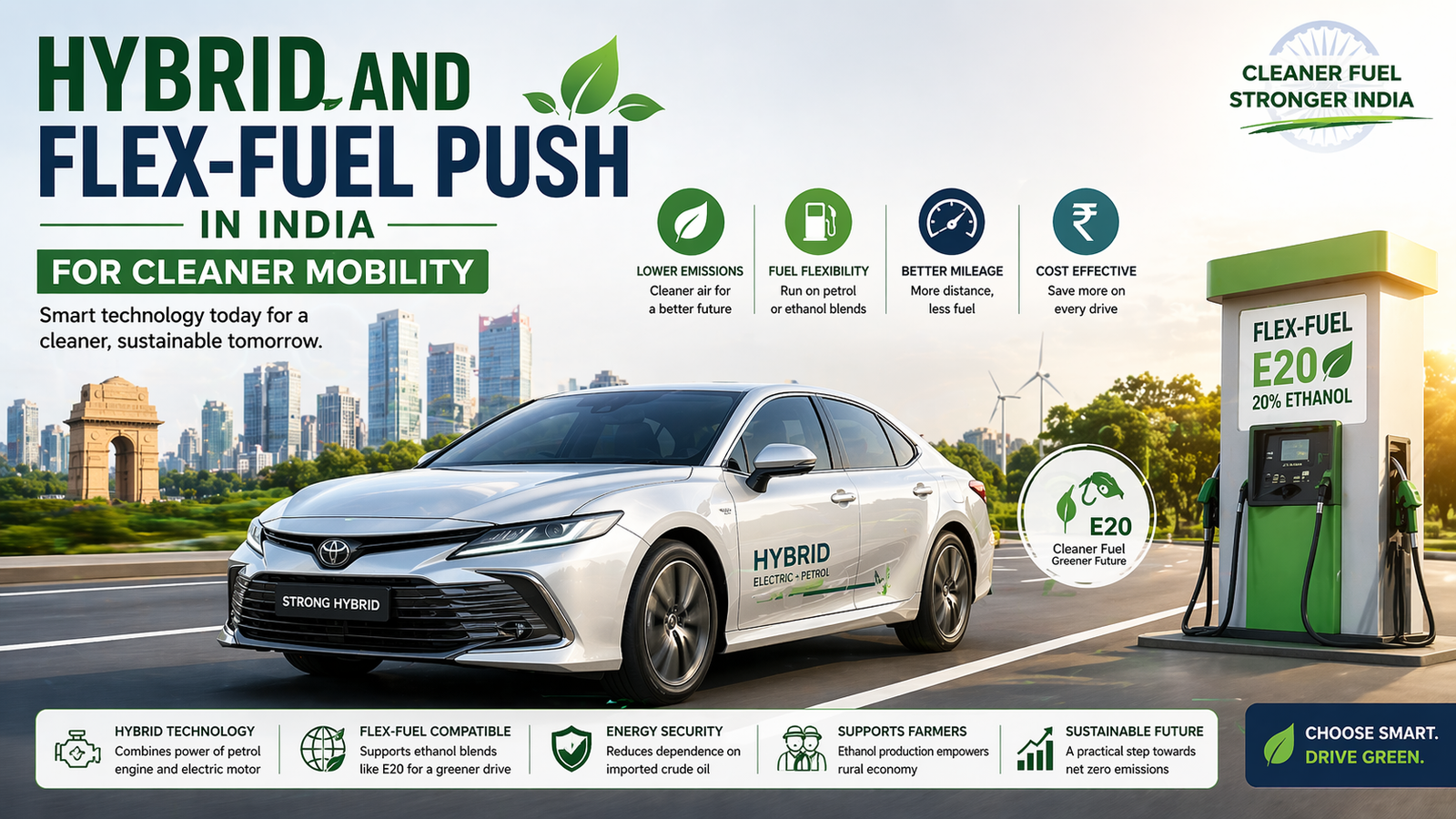
Hybrid and Flex-Fuel drive in India – Viable route for lower emissions Hybrid and Flex-Fuel Push in India – Practical Route to Lower Emissions
Discover how India’s hybrid and flex-fuel drive can reduce emissions, save on fuel costs, and accelerate cleaner mobility without waiting for full EV adoption.
flex fuel cars India, ethanol blending India, E20 fuel India, strong hybrid benefits, green mobility transition, alternative fuels India, hybrid cars India
Introduction
India’s road to cleaner mobility is not a one-lane highway to full electrification. As EVs grow, a parallel and highly practical movement is gaining momentum—the Hybrid and Flex-Fuel Push. These technologies cut emissions and fuel consumption through existing infrastructure, offering an immediate, scalable path toward sustainability.
Hybrids and flex-fuel vehicles are a realistic bridge between conventional petrol cars and fully electric mobility, especially in a diverse market like India where access to charging, price sensitivity and long travel distances are important considerations.
What’s the Hybrid, Flex-Fuel Drive?
The Hybrid and Flex-Fuel Push is defined as policy, industry and consumer momentum toward:
- Hybrid vehicles use a combination of electric motors and petrol engines.
- Flex-fuel vehicles that can run on petrol mixed with higher ethanol content (e.g. E20)
In combination, they cut tailpipe emissions, reduce dependence on crude oil and improve fuel economy, without requiring a change in consumer behavior.
What is a Hybrid Vehicle?
Hybrid vehicles run on two sources of power, an internal combustion engine and an electric motor.
Hybrid Types
- Mild Hybrid – Boosts engine, improves mileage
- Strong Hybrid – can go short distances on electric power only
- Plug-in Hybrid (PHEV) – longer battery run on the plug
Strong hybrids are especially relevant to India for the fact that they deliver EV-like efficiency without charging anxiety.
Flex-Fuel Vehicles Explained
Flex fuel vehicles are made to run on petrol blended with ethanol such as E20 (20% ethanol, 80% petrol).
“Ethanol is made from agricultural products, such as sugarcane and grain, making it renewable and locally available.” This helps farmers and reduces oil imports.
Why Hybrid and Flex-Fuel is Good for India
1. No dependency on charging
Unlike EVs, hybrids and flex-fuel cars can use existing fuel stations.
2. Accelerated Emissions Reduction
They cut emissions from day one, without waiting for charging networks
3. Transition to Economy
They are less expensive than EVs and demand little change in lifestyle.
4. Suitable for long distances
Perfect for highways and rural areas where EV charging is limited.
Environmental Advantages
- Lower CO2 emissions than pure petrol cars
- More fuel efficient
- Fewer fossil fuels
- Renewable ethanol fuel promotion
Economic and Rural Impacts
The flex-fuel ecosystem raises the demand for ethanol, which is good for the farmers and sugar mills of India. This creates a circular economy where agriculture fuels clean mobility.
Push challenges for flex-fuel and hybrids
- Higher upfront price of strong hybrids
- The need for engine modifications to be compatible with E20.
- Consumer knowledge of the benefits
- Transparent tax and incentive policies
Government Policy Role
India’s push for ethanol blending targets and support for alternative fuels are speeding up the readiness of flex-fuel. At the same time, discussing hybrid incentives can enhance their attractiveness to buyers.
EV vs Hybrid vs Petrol – Real World Comparison
| Factor | Petrol Vehicle | Hybrid vehicle | EV |
|---|---|---|---|
| Cost of Fuel | High | Low | Extremely low |
| Releases | High | Low | Zero tail pipe |
| Charge needed | None | None | Yesss |
| Range Anxiety | None | None | Yesss |
| Upfront fees | Low | Average | High |
Hybrids and flex-fuel vehicles are clearly a practical compromise.
Consumer point of view
The things buyers want:
- Better fuel economy
- Lower operating costs
- No charging stress
- Long-haul reliability
Hybrids and flex fuel vehicles fit all these bills.
Readiness for Industry
Automakers can adapt existing platforms for hybrid systems and E20 compatibility more quickly than they can create entirely new EV architectures. This speeds up the time to market.
The Future Road
With India heading towards cleaner mobility, the market will likely see:
- More powerful hybrid models
- More E20 fuel available
- Pricing economies of scale
- More awareness and adoption
The Hybrid and Flex-Fuel Push is not an alternative to EVs, but a complementary pathway to accelerate emission reduction today (Hybrid and Flex-Fuel Push).
SUMMARY
India’s clean mobility transition needs to be inclusive, practical and scalable The Hybrid and Flex-Fuel Push delivers just that – lower emissions, lower fuel costs and little disruption to consumers (Hybrid and Flex-Fuel Push).
EVs are the future, but hybrids and flex-fuel vehicles are the best tools we have right now. In combination, they form a well-balanced roadmap to a greener automotive ecosystem (Hybrid and Flex-Fuel Push).
ALSO READ: Unraveling DTC Code P0113 Intake Air Temperature Sensor 1 Circuit High
ALSO READ: Fixing P0016 in Skoda, VW, and Audi: A Step-by-Step Diagnosis