
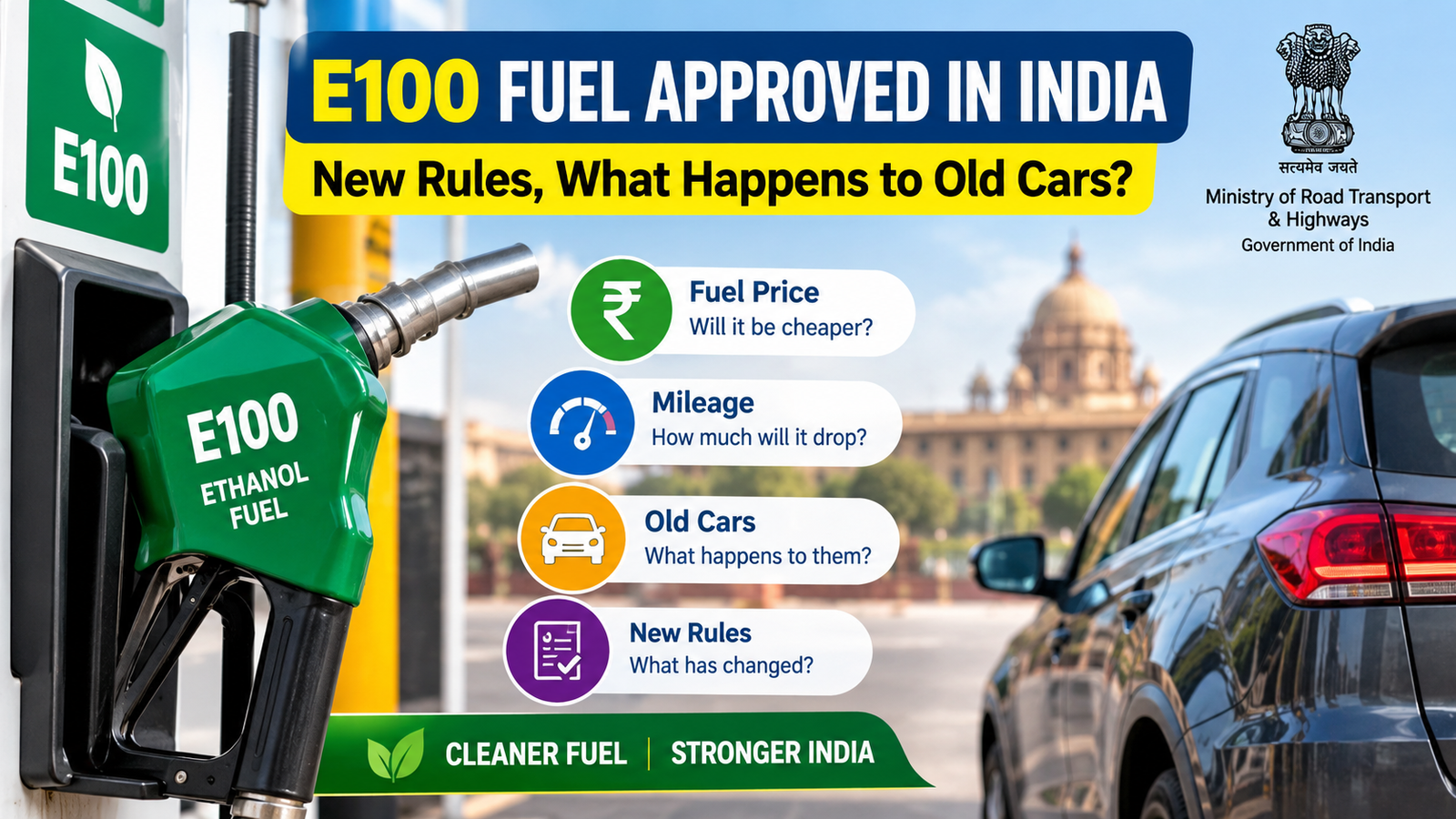
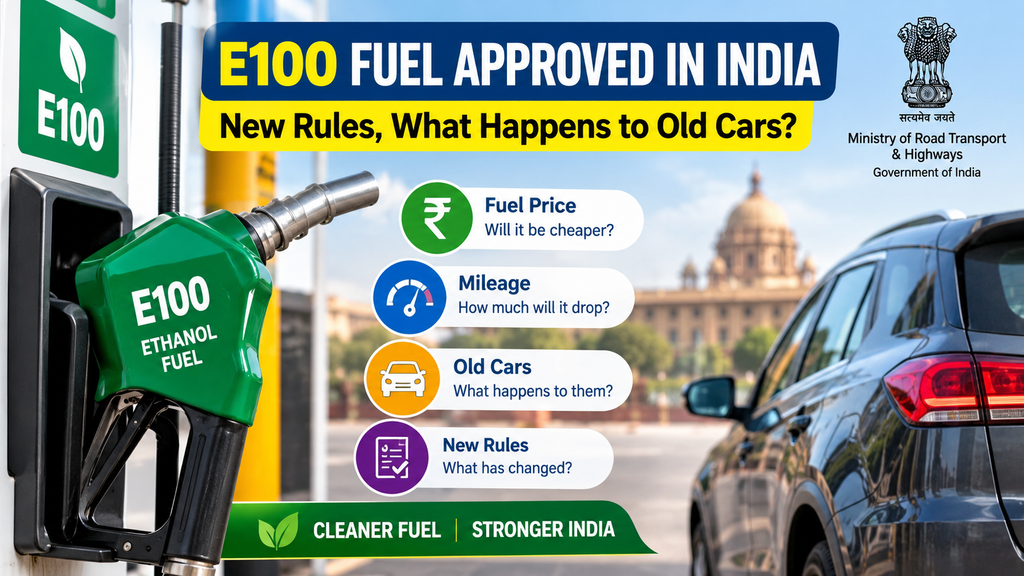
E100 fuel has received regulatory approval in India. Learn about the new government rules, vehicle compatibility, old petrol cars, mileage, fuel prices and flex-fuel technology.
Table of Contents
Introduction
India is exploring alternative fuels to reduce dependence on imported crude oil and encourage cleaner mobility. The E100 Fuel Approval in India development is an important step in this direction, as it establishes a regulatory framework for using fuel containing up to 100% ethanol in compatible vehicles. However, the decision raises an important question for millions of motorists: what happens to older petrol cars and motorcycles? Will existing vehicles be allowed to use E100, or will special flex-fuel technology be necessary? Understanding the E100 Fuel Approval in India rules is essential for vehicle owners who want to know whether this new fuel will affect their daily driving, maintenance expenses and future vehicle purchases.
1. What Is E100 Fuel?
The E100 Fuel Approval in India refers to the government’s decision to recognise E100 within the emission-certification framework for compatible flex-fuel vehicles. E100 refers to fuel consisting almost entirely of ethanol, while E85 contains approximately 85% ethanol.
Ethanol can be produced from agricultural materials such as sugarcane and other biomass. Using domestically produced ethanol could help India reduce its dependence on imported crude oil and support the country’s biofuel industry. However, the environmental benefits depend on how the ethanol is produced and transported.
2. What Rules Has the Government Changed?
The Ministry of Road Transport and Highways amended the Central Motor Vehicles Rules, 1989, through notification G.S.R. 911(E). Published in the Gazette on October 26, 2026, the amendment adds E100 alongside E85 in specified emission-related provisions.
The E100 Fuel Approval in India establishes a formal regulatory route for manufacturers to develop and certify vehicles capable of running on higher ethanol blends.
The key points are:
- E100 is recognised in the applicable vehicle emission-certification framework.
- Manufacturers can certify suitable flex-fuel vehicles for E100 use.
- Vehicles must meet the relevant emission and safety requirements.
- High-ethanol fuel is restricted to vehicles specifically designed and certified for it.
This is a regulatory step towards introducing compatible vehicles, not an instruction for every motorist to change fuels.
3. What Will Happen to Old Petrol Cars?
This is the most important question for existing vehicle owners. The E100 Fuel Approval in India does not require older petrol cars or motorcycles to be replaced, modified or converted to ethanol fuel.
Owners can continue using the fuel specified by their vehicle manufacturer. Conventional petrol vehicles and vehicles designed only for E20 should not be filled with E100 simply because the government has approved the fuel for compatible vehicles.
Ethanol compatibility depends on several components, including fuel lines, seals, injectors, the fuel tank and engine calibration. A vehicle designed for E20 is not automatically capable of operating on E100.
Therefore, the E100 Fuel Approval in India is not a reason to sell an older car or spend money on an unapproved conversion kit.
4. Can E20-Compatible Vehicles Use E100?
No. E20 compatibility alone does not establish that a vehicle can use E100. The government’s clarification specifically limits E85 and E100 to vehicles designed and certified by the original equipment manufacturer as flex-fuel vehicles.
Before choosing fuel, check the compatibility sticker on your vehicle and read the owner’s manual. If the information is unclear, contact an authorised service centre.
The E100 Fuel Approval in India should encourage buyers to check fuel compatibility before purchasing a future vehicle, rather than assuming all petrol engines can use every ethanol blend.
5. Will E100 Fuel Be Cheaper Than Petrol?
The E100 Fuel Approval in India does not automatically mean E100 will be cheaper at petrol pumps. Its retail price will depend on production costs, taxation, transportation, distribution and the availability of dispensing infrastructure.
Ethanol also contains less energy per litre than petrol. Consequently, a vehicle may consume more litres of E100 to cover the same distance, even when its engine is properly designed for the fuel.
For consumers, the most useful comparison will be the cost per kilometre, not simply the price per litre. Actual savings can only be assessed once reliable retail prices and vehicle-specific efficiency figures are available.
6. Will E100 Improve the Environment?
The E100 Fuel Approval in India could support India’s efforts to diversify transport fuels and reduce dependence on imported petroleum. Ethanol made from suitable renewable feedstocks may also lower lifecycle greenhouse gas emissions.
However, the overall environmental impact depends on agricultural practices, energy used in production, transportation and land use. E100 should not automatically be considered emission-free.
7. When Will E100 Become Widely Available?
The E100 Fuel Approval in India creates a clearer path for manufacturers to introduce compatible vehicles, but regulatory approval does not guarantee immediate nationwide fuel availability.
Retail infrastructure, fuel quality standards, vehicle production and manufacturer certification will all influence adoption. Motorists should wait for official announcements regarding local availability rather than assuming E100 can already be purchased everywhere.
Frequently Asked Questions (FAQs)
1. Has the Indian government approved E100 fuel?
Yes. The E100 Fuel Approval in India was formalised through amendments to the Central Motor Vehicles Rules, 1989, allowing certified flex-fuel vehicles to use E100.
2. Will old petrol cars be banned?
No. The E100 Fuel Approval in India does not introduce a ban on older petrol vehicles or require owners to replace them.
3. Can I use E100 in my E20-compatible car?
No, unless your vehicle is specifically designed and certified for E100. E20 compatibility does not establish E100 compatibility.
4. Will E100 damage older vehicles?
Using E100 in a vehicle that is not designed for it may cause fuel-system compatibility problems and improper engine operation. Follow the manufacturer’s fuel recommendations.
5. Will E100 be available at every petrol pump?
Not immediately. The E100 Fuel Approval in India establishes a regulatory pathway, but wider availability depends on supply and retail infrastructure.
Conclusion
The E100 Fuel Approval in India is an important development in the country’s transition towards alternative transport fuels. It creates a regulatory framework for manufacturers to introduce vehicles that can operate on very high ethanol blends, potentially helping diversify India’s fuel supply.
For existing car and motorcycle owners, the main takeaway is reassuring: there is no requirement to modify or replace your vehicle because of this rule change. Continue using the fuel recommended by your manufacturer.
As the E100 Fuel Approval in India moves towards practical implementation, buyers should pay attention to certified flex-fuel vehicles, fuel availability, running costs and manufacturer guidance before making any decisions.
Disclaimer
This article is for general informational purposes and reflects publicly reported information available as of October 29, 2026. Fuel compatibility, availability and vehicle regulations may change. Always consult official government notifications, your vehicle’s owner’s manual and an authorised service centre before changing fuel types.
Also read-
Maruti Suzuki Brezza 2026: कीमत, माइलेज, फीचर्स और लॉन्च डेट – क्या यह बनेगी 2026 की सबसे बेस्ट SUV?
2027 Audi Q9 Review: Titanic Three-Row Rival to GLS, X7
Toyota Innova Hycross Facelift to Debut on November 26
Renault Duster Hybrid Review: Sets a New Benchmark for Hybrids